
- A modular line for fruit and vegetables is a post-harvest plant built from independent blocks (conveyors/buffers, sorting/grading, weighing, packaging, labelling, palletising) that can be added or reconfigured over time without rebuilding the entire plant.
- Modular lines pay off above all when the company has a broad product mix, strong seasonality, frequent format changeovers or a phased growth plan: in these scenarios modularity makes it possible to invest step by step and to adapt capacity and packaging.
- The benefits are measured on concrete KPIs: OEE (availability × performance × quality), waste reduction, reduction of weight giveaway in the pack, productivity in kg per operator-hour, format changeover times and number of complaints.
- The ROI of a modular line improves when the plant is designed as a system (layout + synchronisation + data) and not as a sum of isolated machines.
- The most costly mistakes are sizing for the wrong peak, underestimating format changeovers and integrating data and traceability too late.
Updated: August 2026 Methodological note. This article is based on Bulltec’s public technical documentation (products page and content on post-harvest automation for fruit and vegetables) and on standard concepts for measuring plant performance (OEE, giveaway, waste). No customer result data is reported: where figures appear, they are given as calculation examples or methodological definitions, not as measured benchmarks.
What a modular line is in post-harvest and what sets it apart from a “closed” line
A modular line for fruit and vegetables is a post-harvest processing plant made up of independent, interconnected functional blocks, each responsible for one stage of the flow: reception, conveying and accumulation (buffer), sorting and grading, weighing, packaging, labelling and palletising. Each module can be sized, replaced or added separately, while maintaining mechanical and IT compatibility with the others.
The difference compared with a “closed” (or monolithic) line is substantial. A monolithic line is conceived as a single plant, optimised for a specific product and format: changing packaging, increasing throughput or introducing a new product line often requires rebuilding substantial portions of the plant. A modular line, by contrast, is designed so that the layout, connection points and data flow are scalable from the outset.
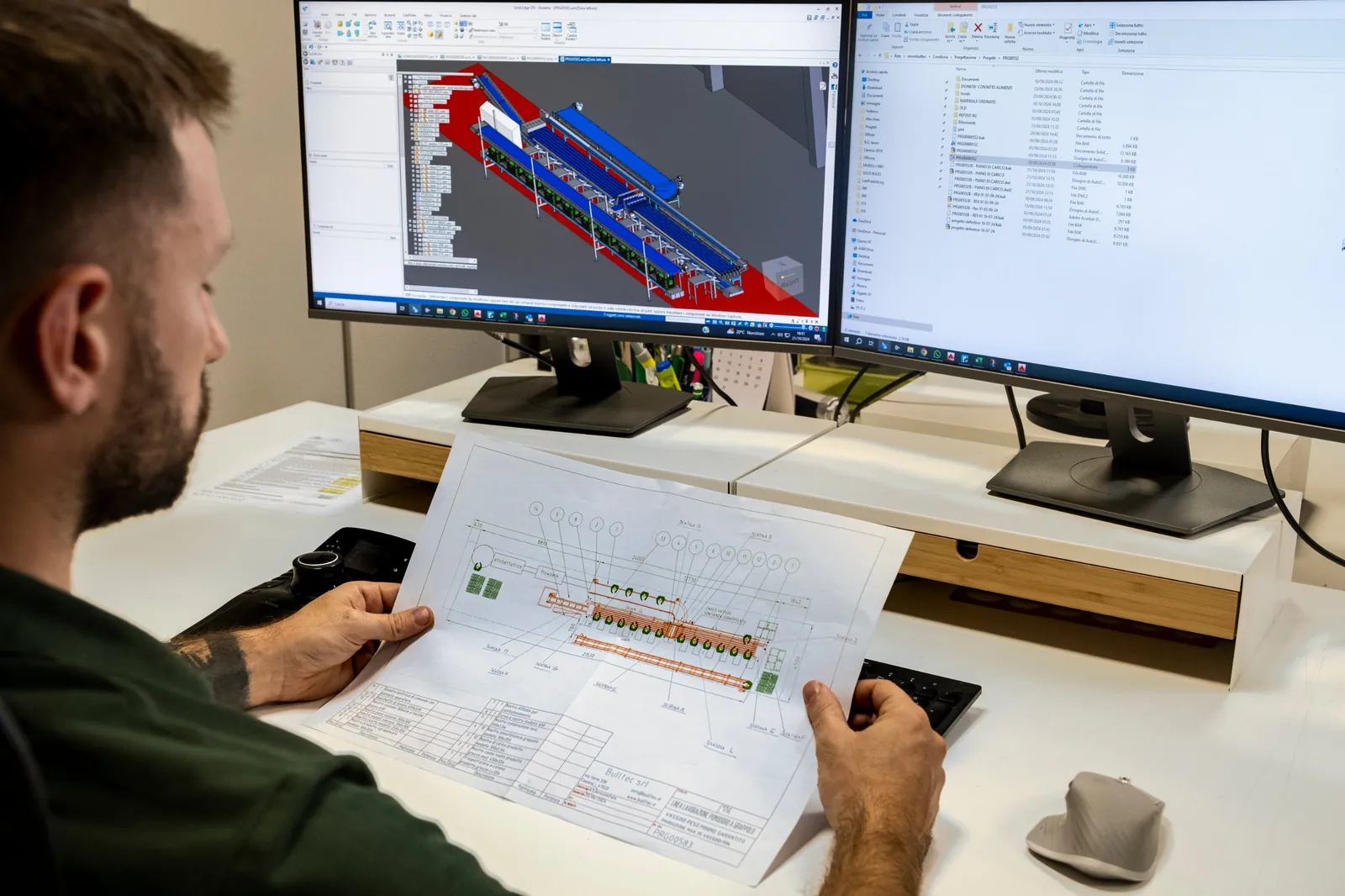
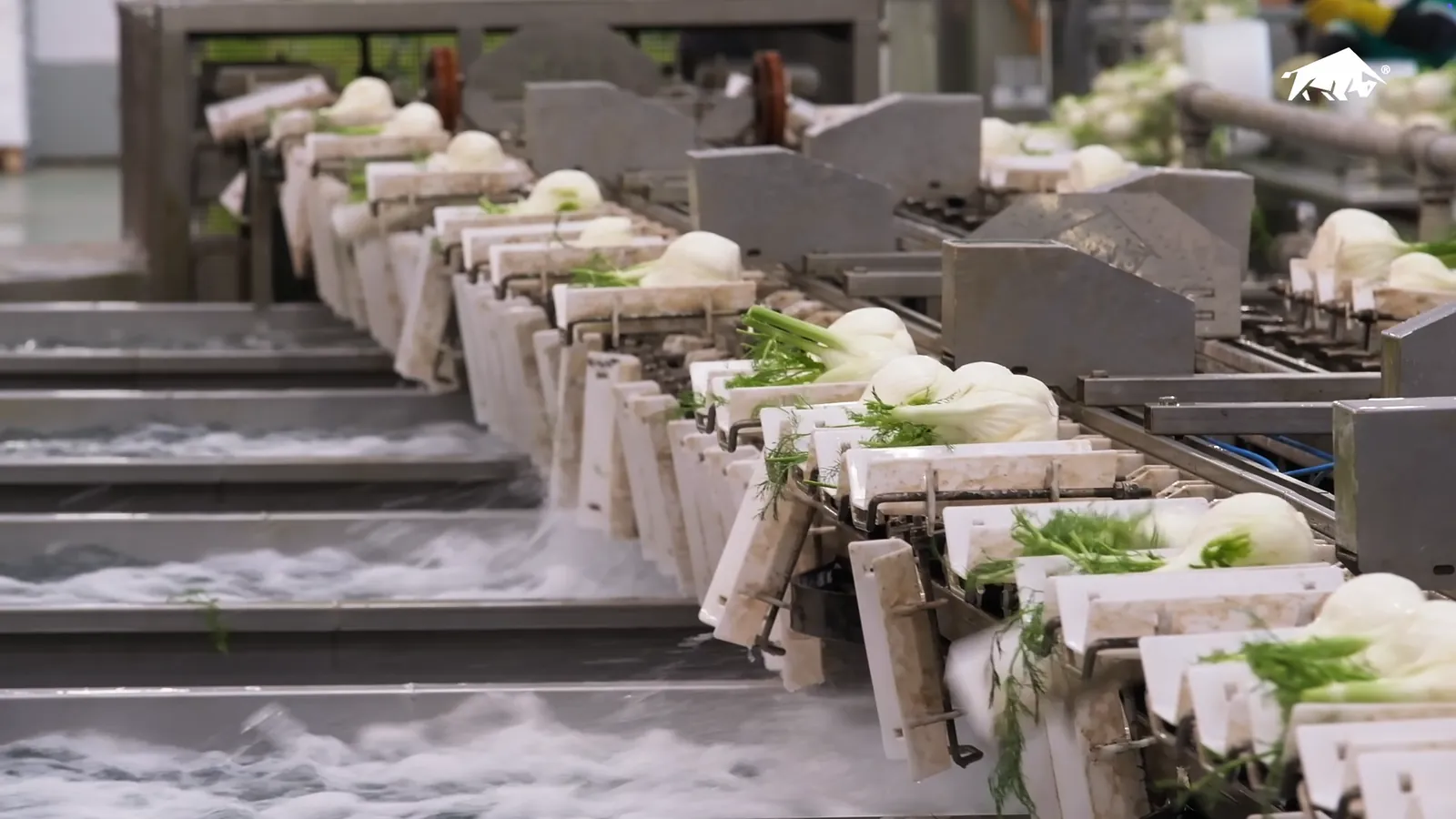
Bulltec designs bespoke complete lines for fruit and vegetables starting from its own electronic grading modules — including electronic paddle graders and solutions dedicated to specific products such as fennel — which form the “sorting/grading” core of a modular configuration.
The two flows every modular line must manage
A modular line manages two flows at the same time. The material flow is the physical path of the product: from the bin at reception to the finished pallet. The data flow is the path of information: batch, weight, size, quality category, waste, label and logistics unit. In a well-designed modular line, each module generates data that feeds performance KPIs and traceability.
When the data flow is added afterwards, rather than designed together with the material flow, the line loses much of its measurable value: this is one of the recurring mistakes described in mistakes to avoid when designing a modular line for fruit and vegetables.
When it really pays off: typical scenarios
A modular line pays off when the variability of the business makes a single, rigid investment risky. Below are the scenarios in which modularity offers the clearest economic advantage.
Broad product mix. A company that processes several product lines (for example salads, fennel, citrus fruit, stone fruit) in different formats gains from modularity the ability to share common modules (conveyors, buffers, weighing) and to specialise only the grading and packaging modules required by each product. Strong seasonality. When volumes vary significantly over the year, modularity makes it possible to activate additional modules (packaging lines, sorting stations) during peaks and to reduce fixed labour in low-load periods. Frequent format changeovers. If the plant often switches from punnets to flowpack, or from nets to cartons, format changeover times directly affect availability (part of OEE). A modular architecture with fast format changeovers reduces stoppages. Phased growth. A company that does not want (or is unable) to commit its entire capex to a single solution can start Step 1 (for example sorting + weighing), verify the results and add Step 2 (automatic packaging) and Step 3 (labelling and palletising) in the following months.
Table: modular line vs monolithic line
| Criterion | Modular line | Monolithic (“closed”) line |
|---|---|---|
| Initial investment | Can be spread over steps | Concentrated, single |
| Format/packaging changeovers | Manageable on the individual module | Often require extensive work |
| Throughput scalability | Addition of modules/stations | Limited by the original sizing |
| Adaptation to new product lines | Dedicated grading/packaging module | Frequent plant redesign |
| Risk of obsolescence | Replacement of the single block | Replacement of large portions |
| Complexity of data integration | To be designed from the outset | To be designed from the outset |
How to translate these scenarios into figures is explored in the content dedicated to calculating ROI and KPIs (OEE, waste, giveaway) for a modular line.
Measurable benefits: OEE, waste, giveaway, productivity and complaints
The value of a modular line must be measured on economic indicators, not just on nominal speed. These are the KPIs that make cost-effectiveness verifiable.
OEE (Overall Equipment Effectiveness)
OEE is the indicator that measures the overall efficiency of a plant and is defined as the product of three factors: availability × performance × quality. Availability falls with stoppages and slow format changeovers; performance falls when the line runs below its ideal speed; quality falls when waste and rework increase. A modular line acts on all three factors: faster format changeovers (availability), controlled buffers that prevent jams (performance), more consistent grading (quality).
Waste reduction
Avoidable waste arises from impacts, jams, uncontrolled buffers and inconsistent settings between operators. A modular flow with gentle conveying and regulated accumulation reduces mechanical damage to fresh produce. Waste reduction translates directly into more saleable product for every bin received.
Weight giveaway reduction
Giveaway is the average overweight given away in fixed-weight packaging: to avoid underweight packs, operators tend to load excess weight. This overweight, multiplied by the number of packs produced in a year, is a silent but significant cost. A combination weighing (multihead) module reduces giveaway by bringing the actual weight closer to the declared nominal weight.
Calculation example (methodological, not customer data): if a line produces 20,000 packs a day with an average giveaway of 8 grams, the daily overweight is 160 kg of product given away. Over 250 operating days this becomes 40,000 kg a year. The economic value depends on the product price, but the calculation method remains the same: packs/day × grams of giveaway × operating days.
Productivity and complaints
Productivity is measured in kg per operator-hour: by automating repetitive stages (unloading, feeding, end of line, palletising), the kilos processed per hour of human labour increase. Complaints fall when grading and sorting reduce the “operator-dependent” effect and make quality standards replicable, as described in Bulltec’s content on post-harvest automation for fruit and vegetables.
Modular architecture: from conveyors to traceability
A modular line for fruit and vegetables is made up of functional blocks connected in sequence along the material flow. Understanding what each module does helps decide where to invest first.
Conveyors and buffers
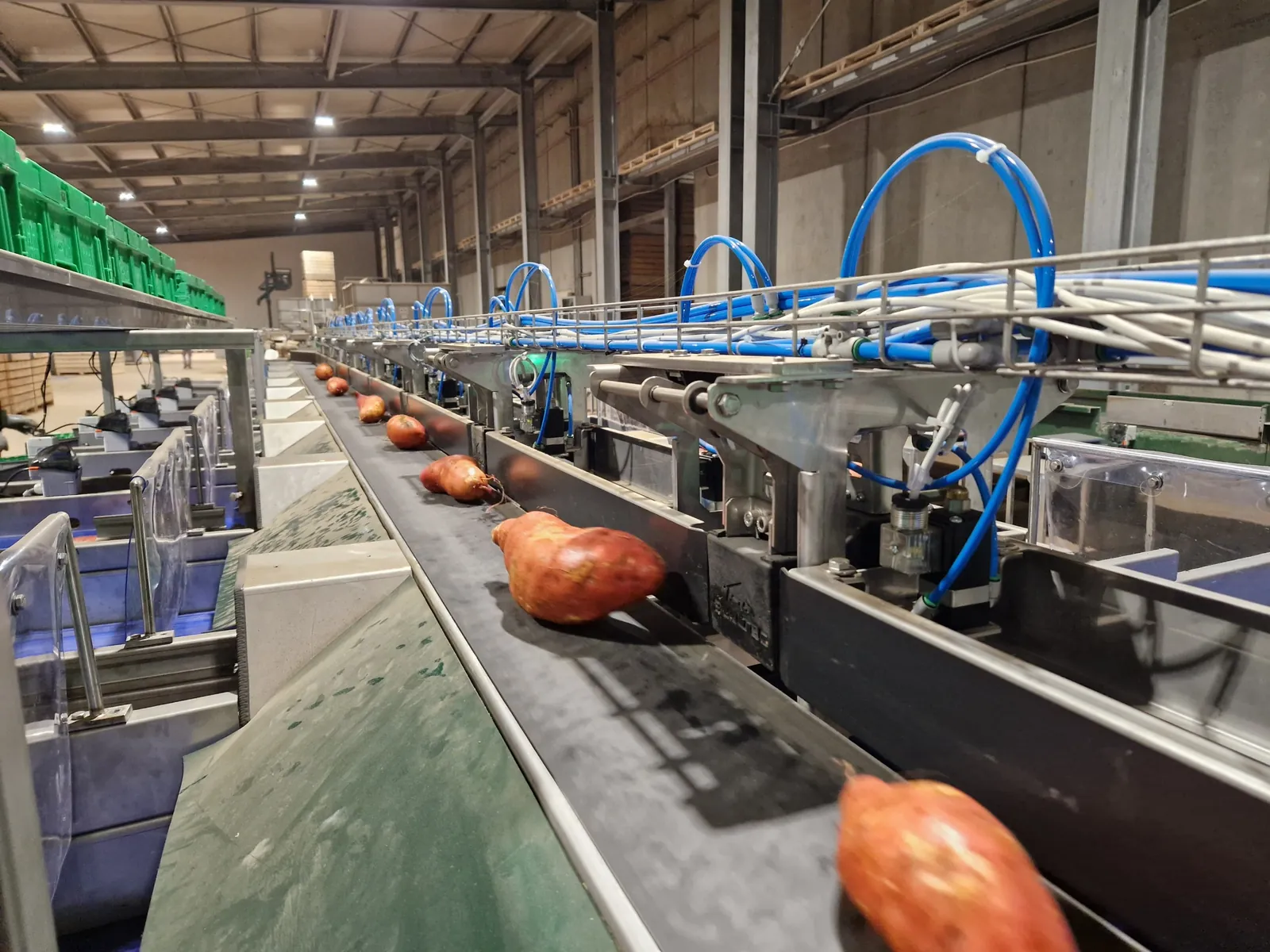
Conveyors move the product between modules; buffers (accumulation areas) absorb differences in pace between stages. A well-sized buffer prevents a slowdown in packaging from stopping grading upstream. Undersized buffers are a frequent cause of stoppages and “shifted” bottlenecks.
Sorting and grading
Sorting separates the product by quality category; grading separates it by weight and/or size. It is the module that determines the consistency of the commercial standard. In this block Bulltec develops its own electronic paddle graders and solutions dedicated to specific products, which makes it possible to specialise grading without touching the other modules.
Weighing
Weighing, typically with combination (multihead) systems, is the key module for reducing giveaway in fixed-weight packaging. More weighing heads allow combinations that come closer to the target weight while minimising overweight.
Packaging and labelling
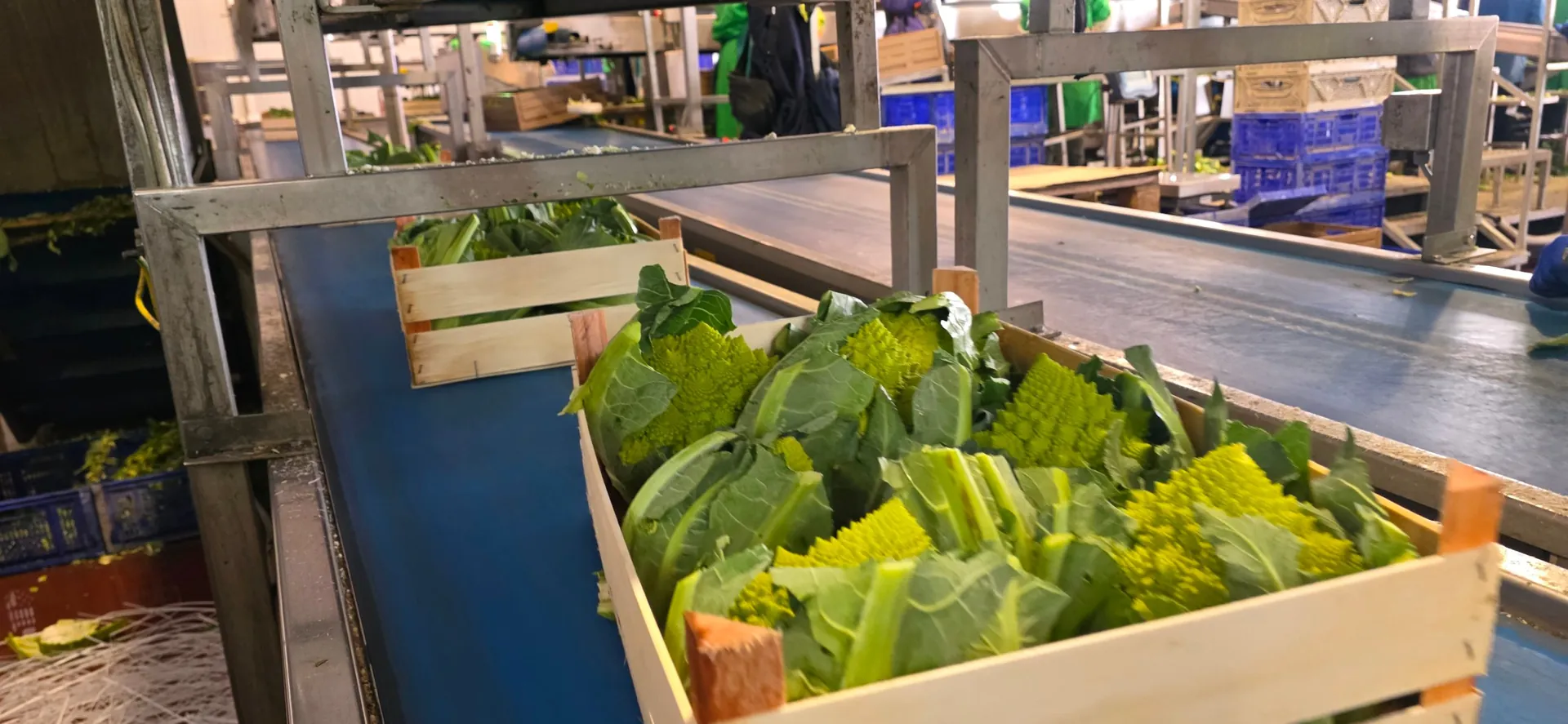
Packaging places the product in its sales pack: punnets, flowpack, nets, cartons or RPCs (Reusable Plastic Containers). Labelling applies weight, price, batch and traceability codes. The choice of these modules depends on the packaging and on the frequency of format changeovers.
Palletising and data integration
Palletising builds the final logistics unit. The data integration module collects batches, weights, waste, labels and pallets, feeding quality and KPIs. How the modules connect is explained in detail in the content on modules and configurations: from reception to packaging in a fruit and vegetable line.
If you are considering which modules to include first in your line, contact the Bulltec team for a bespoke design based on your products and formats.
How to estimate ROI and build a modular roadmap
The ROI of a modular line is built step by step, because each module has its own capex and its own savings. The advantage of the modular approach is that you can invest where the return is fastest and reinvest the savings in the next step.
The three-step method
Step 1 — Measure the baseline. Before any investment, measure the current KPIs: OEE, waste, giveaway, kg per operator-hour, complaints and format changeover times. Without a baseline there is no verifiable ROI. Step 2 — Identify where value is created. Value is typically concentrated in three points: bottlenecks (stoppages and queues), giveaway in the pack (overweight), sorting/routing errors (waste and complaints). Rank these points by economic impact. Step 3 — Calculate the payback per module. For each candidate module, estimate the annual savings (for example the reduction in giveaway or labour) and divide the module’s capex by the annual savings: you obtain the payback in years. Invest first in the modules with the shortest payback.
Typical modular roadmap
A typical phased roadmap includes: Step 1 — sorting/grading and weighing (the modules that stabilise quality and reduce giveaway); Step 2 — automatic packaging (labour reduction at repetitive points); Step 3 — labelling, palletising and full data integration (traceability and KPIs). The detailed calculation model, with capex per module and sensitivity to volumes and mix, is in the content on calculating ROI and KPIs (OEE, waste, giveaway) for a modular line.
Common mistakes and design checklist
Even a modular line can perform poorly if it is badly designed. Here are the most costly mistakes and a checklist to avoid them.
Capacity and layout mistakes
The first mistake is sizing for the wrong peak: designing for an unrealistic peak inflates capex, while designing for the average leaves the line struggling on peak days. The second is an insufficient buffer, which turns every micro-stop of a module into a line stoppage. The third is a non-scalable layout: if connection points for future modules are not planned, modularity remains theoretical.
Process mistakes
Underestimated format changeovers are the most frequent mistake: if you often switch from one packaging to another, changeover time affects OEE more than nominal speed. Another mistake is the “shifted” bottleneck: automating a single fast module without adapting those upstream and downstream simply moves the bottleneck elsewhere. Maintenance and accessibility must also be planned: a module that is difficult to clean or repair lowers availability.
Integration mistakes
The most insidious mistake is adding data and traceability too late: if batches, weights and waste are not collected from the outset, KPIs remain estimates. Equally serious is failing to define KPIs before investing, and aligning automation with speed alone rather than quality. The full list, with remedies, is in the content on mistakes to avoid when designing a modular line for fruit and vegetables.
Quick design checklist
- Have I measured the KPI baseline (OEE, waste, giveaway, kg per operator-hour, complaints)?
- Have I sized for the realistic peak, rather than the average or the extreme?
- Do the buffers absorb micro-stops between modules?
- Does the layout include connection points for future modules?
- Have I estimated the real format changeover times for each type of packaging?
- Is the data flow (batches, weights, waste, labels, pallets) designed together with the material flow?
- Is every module accessible for cleaning and maintenance?
Frequently asked questions (FAQ)
What is a modular line for fruit and vegetables?
A modular line for fruit and vegetables is a post-harvest processing plant made up of independent, interconnected functional blocks: conveyors and buffers, sorting and grading, weighing, packaging, labelling and palletising. Each module can be sized, replaced or added separately while maintaining compatibility with the others. The difference compared with a “closed” line is that the modular line is designed from the outset so that layout, connection points and data flow are scalable, making it possible to adapt capacity, packaging and product lines without rebuilding the entire plant.
When does a modular line pay off compared with a monolithic one?
A modular line pays off when the variability of the business makes a single, rigid investment risky. There are four typical scenarios: a broad product mix (several product lines and formats), strong seasonality of volumes, frequent format changeovers (which affect OEE availability) and phased growth (investment spread over several steps). In these cases modularity makes it possible to share common modules, activate additional capacity during peaks and invest where the return is fastest, reducing the risk of obsolescence of the entire plant.
How are the benefits of a modular line measured?
The benefits of a modular line are measured on economic KPIs, not just on speed. The main ones are OEE (the product of availability, performance and quality), the reduction of avoidable waste, the reduction of weight giveaway in fixed-weight packaging, productivity in kg per operator-hour, format changeover times and the number of complaints. The practical rule is to measure the baseline of these indicators before the investment: without a baseline, it is not possible to verify the real return of the line.
What is giveaway and how does a modular line reduce it?
Giveaway is the average overweight “given away” in fixed-weight packaging: to avoid underweight packs, there is a tendency to load excess weight. Multiplied by the annual number of packs, this overweight is a silent cost. A modular line reduces it thanks to the combination weighing (multihead) module, which brings the actual weight closer to the declared nominal weight. Methodological example: 20,000 packs a day with 8 grams of giveaway equal 160 kg a day and 40,000 kg over 250 operating days.
How is the ROI of a modular line built?
The ROI of a modular line is built in three steps. First: measure the baseline of current KPIs (OEE, waste, giveaway, productivity, complaints, format changeover times). Second: identify where value is created, typically bottlenecks, giveaway in the pack and sorting errors. Third: calculate the payback for each module by dividing its capex by the estimated annual savings, investing first in the modules with the shortest payback. The step-by-step approach makes it possible to reinvest the savings from the first module in the next step.
Which mistakes should be avoided when designing a modular line?
The most costly mistakes in designing a modular line fall into three categories. Capacity and layout mistakes: sizing for the wrong peak, providing insufficient buffers, designing a non-scalable layout. Process mistakes: underestimating format changeover times, automating a single module and shifting the bottleneck, neglecting maintenance and accessibility. Integration mistakes: adding data and traceability too late, failing to define KPIs before investing, aligning automation with speed alone rather than quality.
Sources
- Bulltec — Post-harvest automation for fruit and vegetables: https://bulltec.it/en/post-harvest-automation-for-fruit-and-vegetables-how-to-make-processing-more-efficient-from-reception-to-packaging/
- Bulltec — Products (graders and lines): https://bulltec.it/en/product/
- Bulltec — Electronic paddle graders: https://bulltec.it/en/electronic-paddle-graders/
In summary and next steps
A modular line for fruit and vegetables pays off when product mix, seasonality, format changeovers or phased growth make a rigid plant risky, and its benefits only become verifiable when measured on OEE, waste, giveaway, productivity and complaints. To design your configuration based on your actual products and formats, get in touch with the Bulltec team.
Find out more with the other content in the guide: