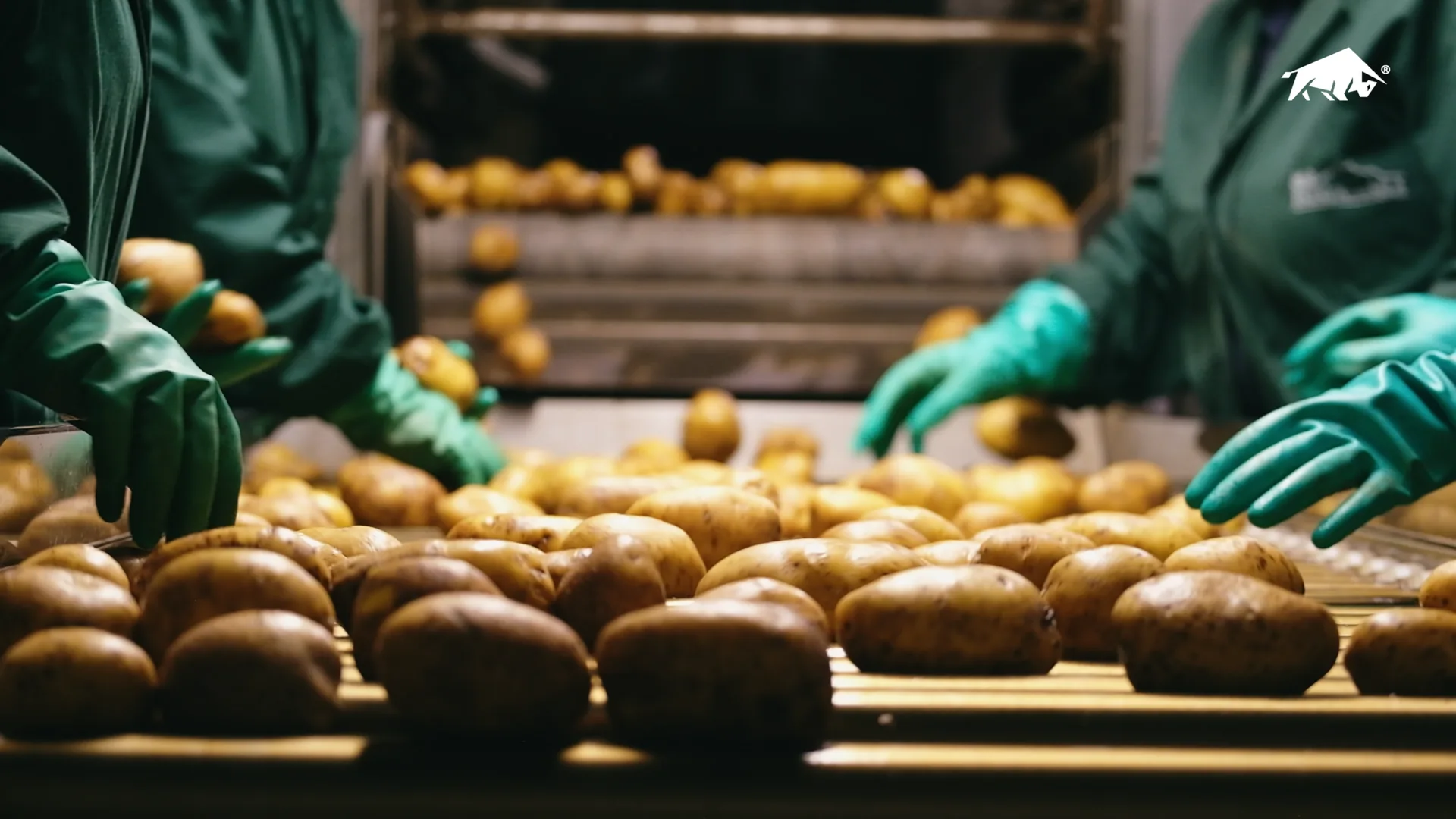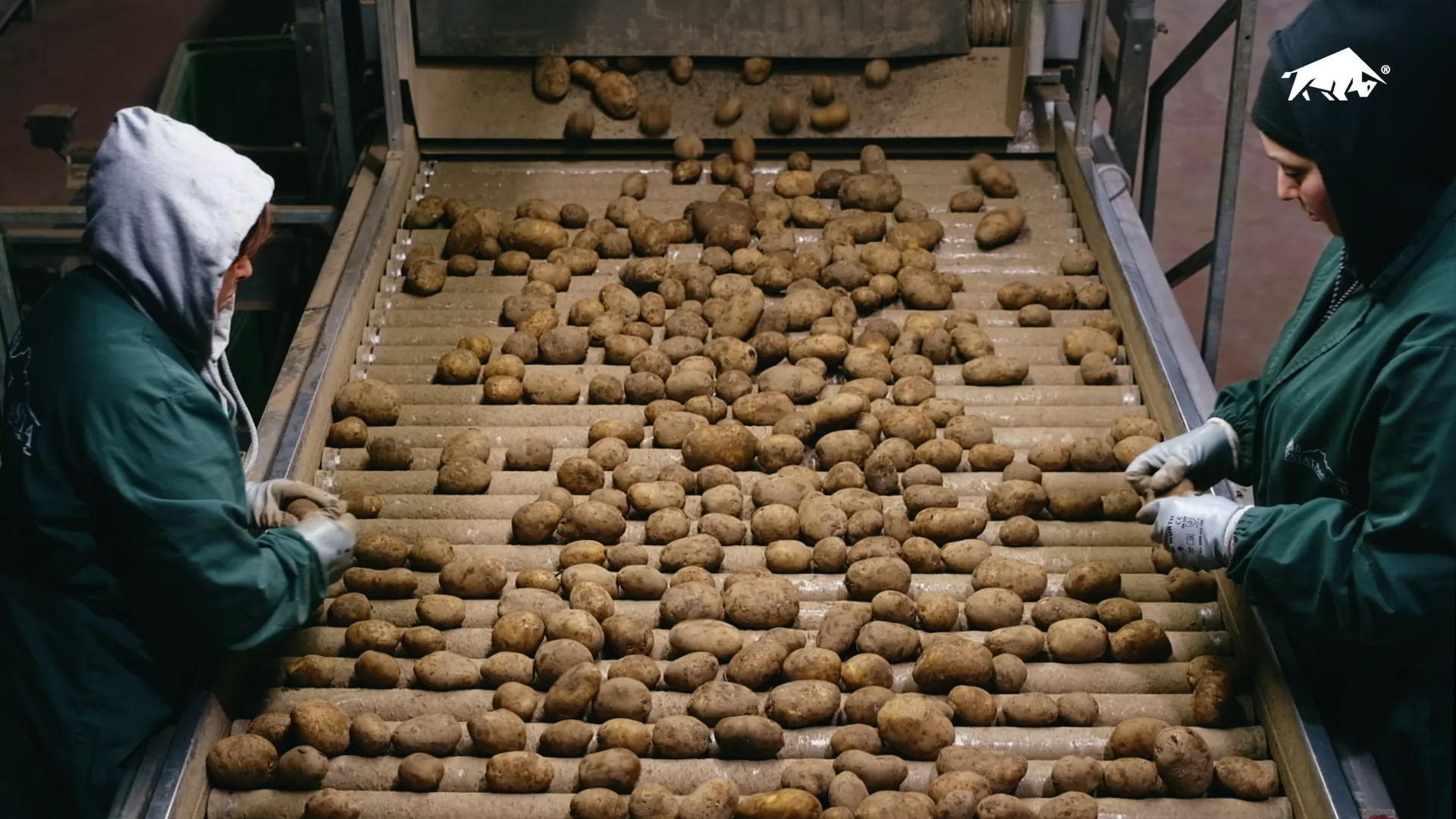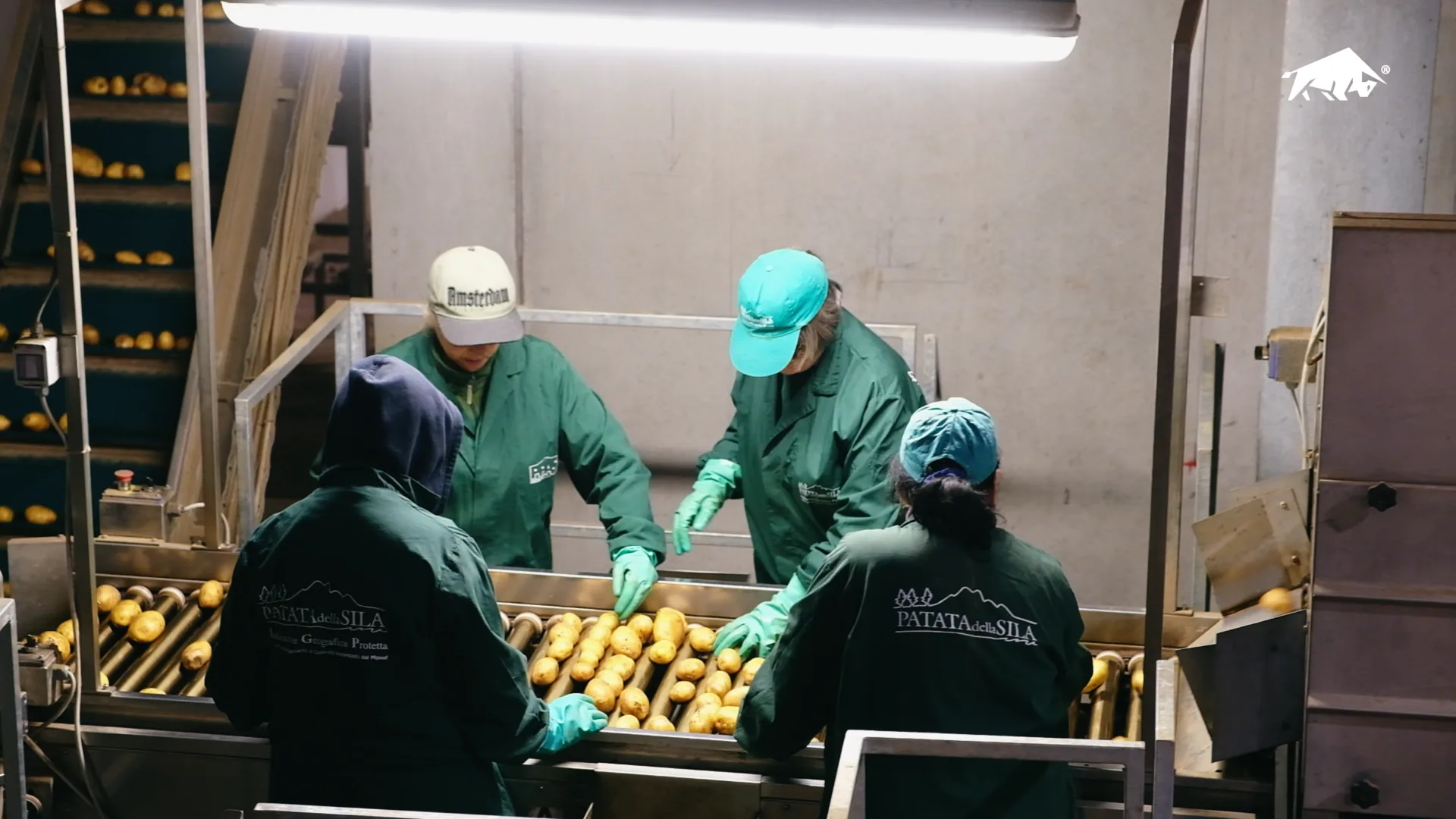

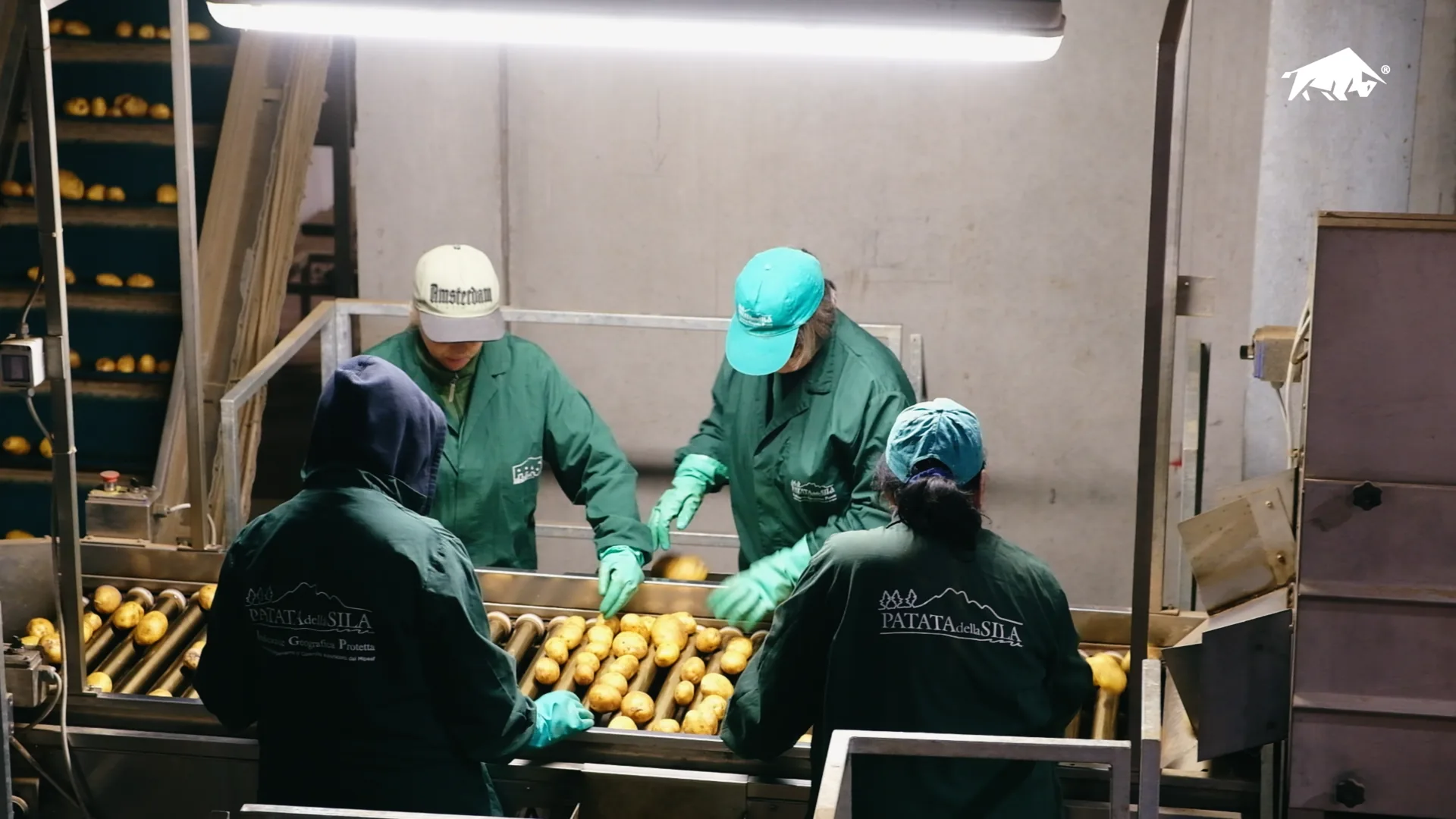
- Potato grading is the stage where each tuber is classified by weight or size: the choice between the two methods depends on the destination market and the packaging format.
- Quality sorting identifies and eliminates visual defects (green, rot, cuts, bruising) through manual, optical and automated controls integrated into the line.
- Handling gentleness is the most underrated parameter: every unnecessary impact or fall turns into delayed waste and lost value at packaging.
- A well-integrated system reduces avoidable waste by up to 15–20% and increases hourly productivity without increasing operational staff.
- Choosing the right technology means knowing the required throughput (t/h), the variety being processed, the incoming degree of soiling, and the expected output formats.
Why potato grading is the heart of the processing line
Imagine receiving a 500 kg bin of freshly harvested potatoes: 30 g tubers coexist with 350 g specimens, perfect potatoes mix with tubers with cuts or green parts, and everything must become a 1 kg or 2.5 kg package within a few hours. Without a structured potato grading and sorting system, this transformation becomes a lottery: batches out of weight range, retail complaints, wasted labor and waste that erodes margins.
Potato grading is the process by which each individual tuber is measured—by weight, by size or by both—and directed toward the outlet corresponding to its commercial class. Quality sorting, which ideally integrates into the same stage or precedes it, separates compliant products from non-marketable ones. Together, these two steps determine production yield, market reputation and the real cost of the process.
To place these steps in the context of the whole supply chain, read the complete guide to potato line stages and machines.
Weight grading vs size grading: when to choose one or the other
This is the question every line manager should ask before purchasing any machine. The two technologies are not interchangeable: they respond to different market needs and produce different effects on the quality of the packaged batch.
Weight grading: commercial precision to the gram
Weight grading weighs each individual tuber in transit on a belt equipped with load cells. Typical precision is ±3% on the weight of the single piece: this means a 200 g potato is classified with a margin of ±6 g, compatible with the tolerances required by modern retail for 1 kg or 2.5 kg sacks.
When to choose it:
- Production destined for packaged retail (fixed-weight sacks, trays, weighted netting).
- Need to minimize giveaway (weight given away for free beyond the declared weight).
- Irregularly shaped varieties (red-skinned potato, new potato) where diameter doesn’t correlate well with actual weight.
- Direct integration with a downstream combination weigher.
Attention to waste: weight grading tends to be gentler because the product passes over flat belts rather than rollers or oscillating grids. The risk of mechanical bruising is reduced, but hourly throughput is slightly lower than pure dimensional grading.
Size grading: speed and visual homogeneity
Dimensional grading classifies tubers by diameter (and in some systems also length or shape) via progressive-hole grids, divergent rollers or—in more advanced systems—cameras with machine vision. Bulltec, with its electronic tray graders, achieves a precision of ±3 mm on diameter, with productivity up to 3 products per second per channel.
When to choose it:
- Horeca and industry markets (processing, frozen, chips) where individual weight is less critical than visual uniformity.
- Baby potato or new potato production where size is the main commercial parameter.
- High-throughput lines (over 10–15 t/h) where speed takes priority over gram-level precision.
- Export destinations with grade classes defined by contract (e.g. 35–55 mm, 55–75 mm, >75 mm).
The hybrid solution: weight + vision in cascade
The best-performing lines adopt a cascade approach: first a dimensional pre-sort that removes obvious oversized and undersized units, then an individual weighing that classifies the product into commercial outputs. This reduces the load on the weigher, increases the precision of the final batch and cuts the manual reclassification rate. To explore further how this choice fits into a complete plant project, see the dedicated page on grading and sorting: how to choose the right technology for potatoes.
Typical potato defects and how to detect them on the line
Quality sorting is not an aesthetic operation: it’s a food safety and commercial control. Every defect not intercepted before packaging is a potential return, a non-conformity or—in the case of green potatoes—a risk to the end consumer (solanine, an alkaloid present in the green part, is toxic at high doses).
Main defects to intercept
| Defect | Cause | Commercial risk | Detection method |
|---|---|---|---|
| Green | Light exposure in the field or warehouse | Toxicity (solanine), retail rejection | Optical vision, UV |
| Rot | Bacteriosis, fungi (e.g. Phytophthora infestans) | Batch contamination | Optical vision + manual inspection |
| Mechanical cuts | Mechanized harvesting, line impacts | Devaluation, rapid decay | 360° optical vision |
| Bruising | Falls, pressure in overcrowded bins | Internal browning, delayed waste | Difficult with vision; mechanical prevention |
| Clods and stones | Residual soil post-washing | Damage to downstream machines | Density separators, optical vision |
| Sprouting | Storage too long or too warm | Regulatory non-compliance | Optical vision, manual inspection |
Quality control points in the line
A structured line includes at least three quality control points before packaging:
- Bin reception — sample visual inspection to assess the percentage of defects in the incoming batch and adjust line speed accordingly.
- Post-washing / pre-grading — manual sorting table or optical sorter that intercepts obvious surface defects (green, deep cuts, rot) before the product enters the grading machine. A clean product also ensures more accurate camera readings. To understand how washing prepares the product for this stage, read the article on potato washing and cleaning: solutions, parameters and how to reduce damage.
- Post-grading / pre-packaging — final check on the output of each class, with possible manual review for defects that escaped optical sorting (light bruising, early sprouting).
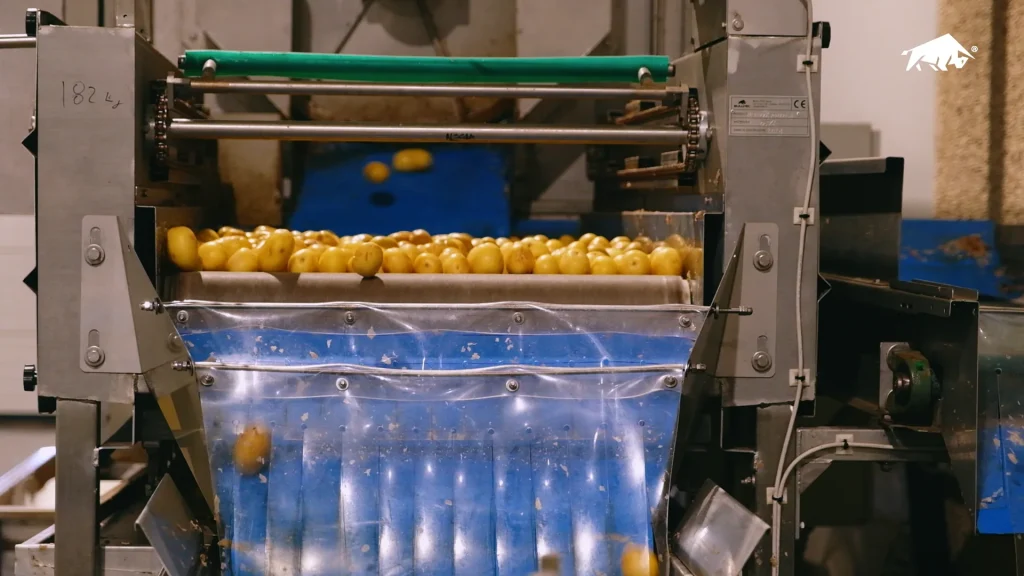
How the electronic tray grader for potatoes works
The Bulltec electronic tray grader is one of the most advanced solutions for grading round and tuberous vegetables.
Its operating principle combines mechanical gentleness with electronic precision:
- Each product is accompanied by an individual tray that opens progressively, eliminating the bouncing and impacts typical of roller or static grid systems.
- Bulltec’s software manages the thresholds for each outlet in real time, allowing size or weight classes to be reconfigured without stopping the line.
- The system is modular and scalable: the machine can be configured with a variable number of outlets per side (up to 8 trays per side in standard configurations) and adapted to existing lines through customized connections and fittings.
Handling gentleness is particularly critical for potatoes, tubers subject to internal browning from impact (IEC – Internal Explosion Cracking): damage that isn’t visible from the outside but manifests after 24–48 hours as dark halos in the flesh, resulting in delayed rejection by the consumer or industrial processing.
Bulltec applies the same gentle-handling philosophy also to sweet potatoes, tubers even more sensitive to impact due to their thin skin and starch-rich flesh.
Integrating grading into the line: feeding, flows and bottlenecks
A high-performing grader mounted on a poorly designed line produces mediocre results. Integration is the critical factor that separates a plant running at full capacity from one that accumulates queues, stoppages and waste.
Regular feeding: the key to precision
The grader works best when it receives a continuous and regular flow of product. Accumulation hoppers, distribution belts with variable speed and automatic bin tippers (part of Bulltec’s RG division) serve exactly this purpose: ensuring the grading machine never receives excessive load peaks nor runs empty.
An optimal machine load is between 75% and 85% of rated throughput: above this, product overlaps occur (with classification errors), below this, productivity is lost and the cost per kg processed rises.
Managing outputs and bottlenecks
Each grader outlet feeds a belt, a combination weigher or directly a bagging machine. If an outlet becomes saturated (because that grade class is predominant that day), the entire line slows down or stops.
Design solutions to avoid this are:
- Intermediate buffers between the grader and weighers to absorb temporary variations in grade mix.
- Reject outlets clearly separated from commercial outlets, with collection in dedicated bins for subsequent rework or disposal.
- Real-time KPI monitoring: waste rate by class, actual hourly productivity, percentage of off-grade product.
This data, collected by the line software, allows the production manager to intervene before a local problem becomes a line stoppage.
Scheduled maintenance: the invisible cost
Tray graders have components subject to cyclical wear (trays, springs, conveyor belts, load cells). A scheduled maintenance plan—ideally planned during the plant design phase—reduces unplanned stoppages and keeps classification precision within declared limits. Spare parts with easily available components, as in the case of Bulltec systems, make the operator self-sufficient in routine management without having to wait for manufacturer support.
Quality control KPIs: how to measure grading performance
A potato grading and sorting system isn’t evaluated only in terms of speed, but through quantitative indicators that reflect the real efficiency of the process.
Fundamental KPIs
- Waste rate (%) — percentage of product eliminated out of the total processed. A waste rate above 5–8% on normal field potatoes is often a sign of incorrect threshold settings or insufficient washing that compromises optical reading.
- Manual reclassification rate (%) — product sent back after grading because it was classified into the wrong class. Values above 1–2% indicate calibration drift that needs checking.
- Packaged batch homogeneity — measured as the standard deviation of piece weight in a sample of 30 units per class. The lower it is, the more precise the grader and the more uniform the product the consumer receives.
- Actual productivity (t/h) — ratio between packaged product and actual production hours (excluding stoppages). The reference benchmark varies depending on variety and format, but a well-sized plant should never fall below 70% of the declared rated throughput.
- Average giveaway (g/package) — weight given away in excess of the declared weight. Every gram of giveaway across millions of annual packages is lost margin. A combination weighing system downstream of the grader typically reduces giveaway by 30–50% compared to manual weighing.
To discover how these KPIs connect with packaging and final weighing, explore the topic further in the cluster dedicated to potato packaging: weighing, formats and end-of-line automation.
Operational checklist: how to configure effective potato grading
Before starting up (or reconfiguring) a potato grading line, check these points:
- [ ] Rated throughput vs actual throughput: the machine is sized for the seasonal peak, not the annual average.
- [ ] Variety and shape: the chosen technology (weight, size, vision) is suitable for the morphology of the tuber being processed (round, oval, elongated).
- [ ] Number and thresholds of outputs: the grade classes match active commercial contracts, not the machine’s default specifications.
- [ ] Regular feeding: a buffer or leveling hopper system exists between washing and grading.
- [ ] Quality control points: at least two sorting moments are planned (pre- and post-grading).
- [ ] Data collection: the software records line KPIs for each shift and variety processed.
- [ ] Maintenance plan: frequencies and responsibilities are defined and documented.
For an overview of how these steps fit into the entire production flow, see the complete guide to potato line stages and machines on Bulltec.
FAQ — Potato grading and sorting
What is the difference between weight grading and size grading for potatoes?
Weight grading measures the mass of each individual tuber via load cells positioned on the conveyor belt, with a typical precision of ±3% on individual weight. It’s the preferred technology when the finished product must meet a declared weight in packaging (1 kg sacks, 2.5 kg netting) because it minimizes giveaway and weight non-conformities. Size grading, on the other hand, classifies tubers by diameter, length or shape, via physical grids, divergent rollers or machine vision systems. It has higher hourly productivity and is suitable for markets where visual size matters more than precise weight, such as catering, processing industry or export for grade classes defined by contract. The two technologies aren’t mutually exclusive: many lines adopt them in cascade to maximize both speed and commercial precision.
Which potato defects are hardest to detect automatically?
Internal impact bruising (IEC – Internal Explosion Cracking) is the most insidious defect because it’s not visible from the outside at the time of packaging, but manifests as flesh browning after 24–48 hours. Optical vision systems effectively detect surface defects such as green, cuts, initial rot and residual soil clods, but they don’t see inside the tuber. For this reason, mechanical prevention—minimizing drop heights, impacts between tubers and pressure stress throughout the line—is more effective than optical control alone. Early-stage sprouts and very light bruising may still require integration with manual review on a direct-light belt.
How often should a potato grader be recalibrated?
Recalibration frequency depends on the type of technology and intensity of use. The load cells of a weight grader should be checked at least every week of intensive production with a sample of certified weights, and recalibrated every 30–60 days or whenever the manual reclassification rate exceeds 1%. Camera vision systems, on the other hand, require a check of optics cleanliness every shift (starch dust and residual water vapor from washing are the main enemies of precision) and a recalibration of parameters every time the variety is changed, since color, reflectance and morphology change significantly between cultivars.
How does grading integrate with automatic packaging?
Optimal integration involves each grader outlet feeding directly into a combination weigher (multihead weigher) or a bagging machine dedicated to the packaging format planned for that grade class. The line software manages the connection between the two systems: when a class is exhausted or the downstream weigher is at saturation, the grader slows down or diverts flow to a buffer. This avoids line stoppages due to accumulation and keeps overall throughput close to rated capacity. Good integration also reduces overall giveaway because combination weighing downstream of grading works on a product already homogeneous in size, optimizing possible combinations to reach the target weight with the least possible excess.
How many outlets are needed on a potato grader for the retail market?
The number of outlets depends on the active commercial classes and the variety being processed. An average retail plant in Italy typically works with 3–5 grade classes (for example: waste <35 mm, baby 35–45 mm, small 45–55 mm, medium 55–70 mm, large >70 mm) plus a reject outlet for defects. Often added to these is an outlet for excess off-grade product (oversized) destined for retail with special formats or for industry. Bulltec graders are configurable according to customer needs, with the possibility of expanding outlets without replacing the entire machine, thanks to the modularity of the tray system and software reprogrammable from the operator panel.