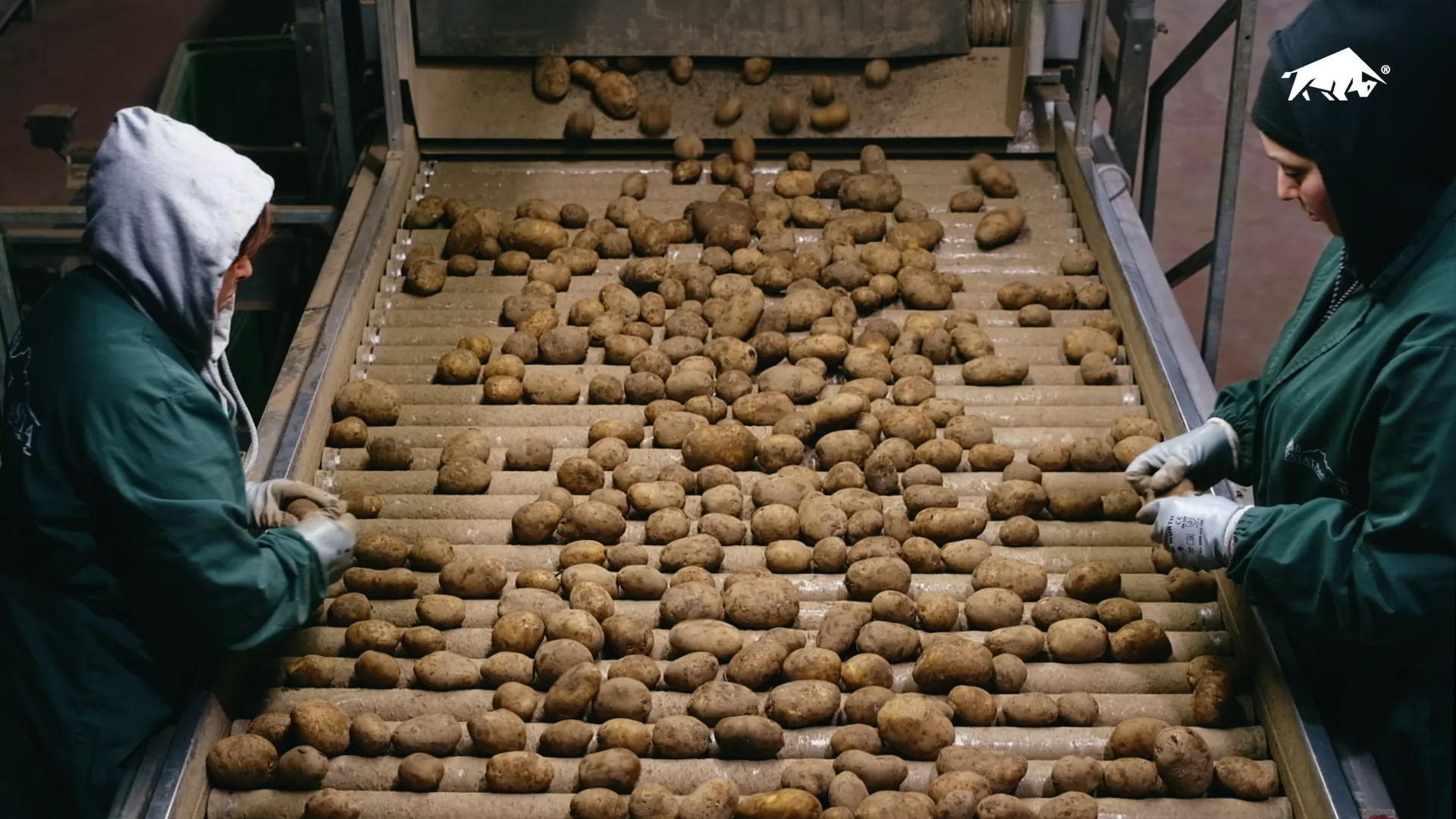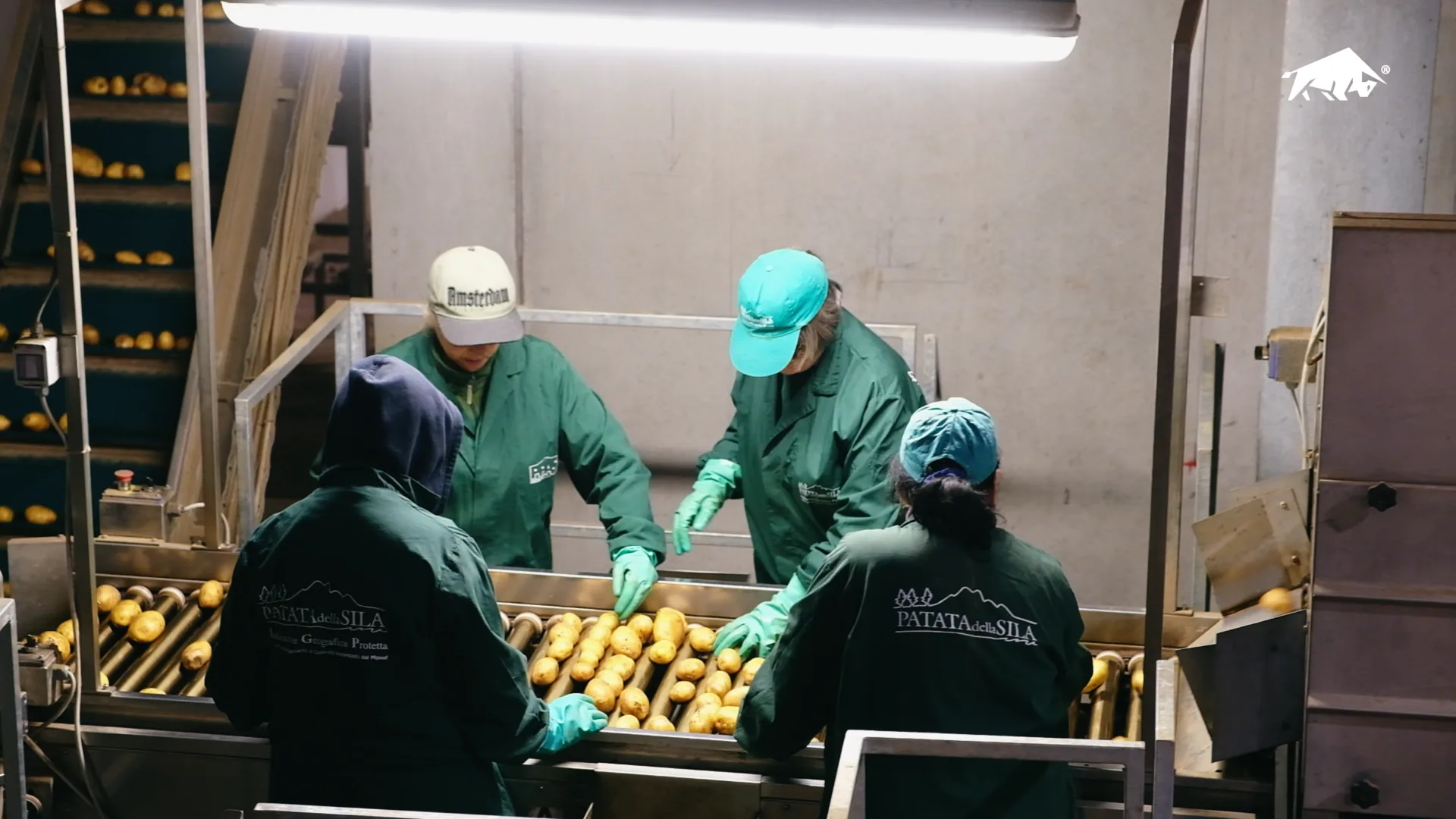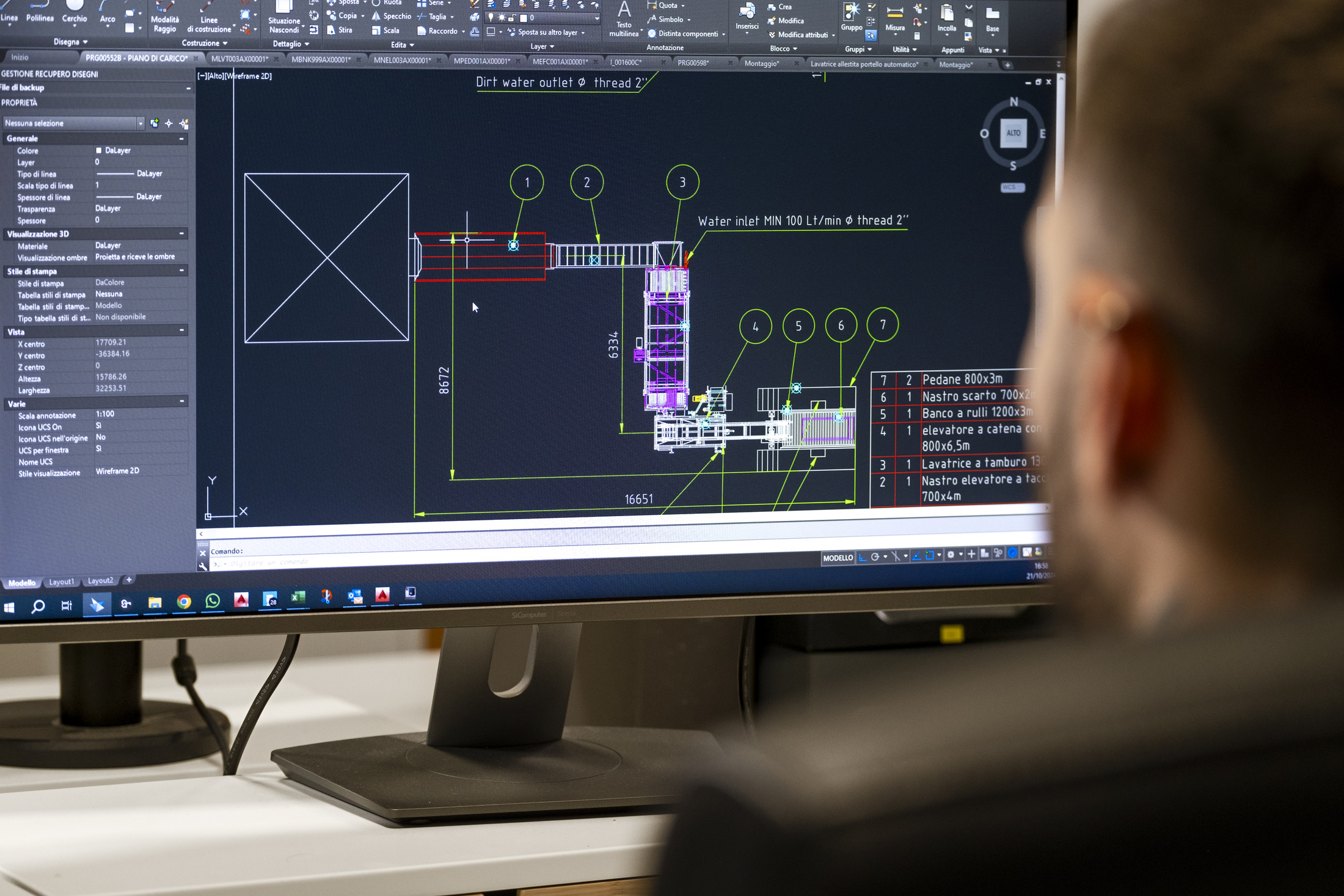

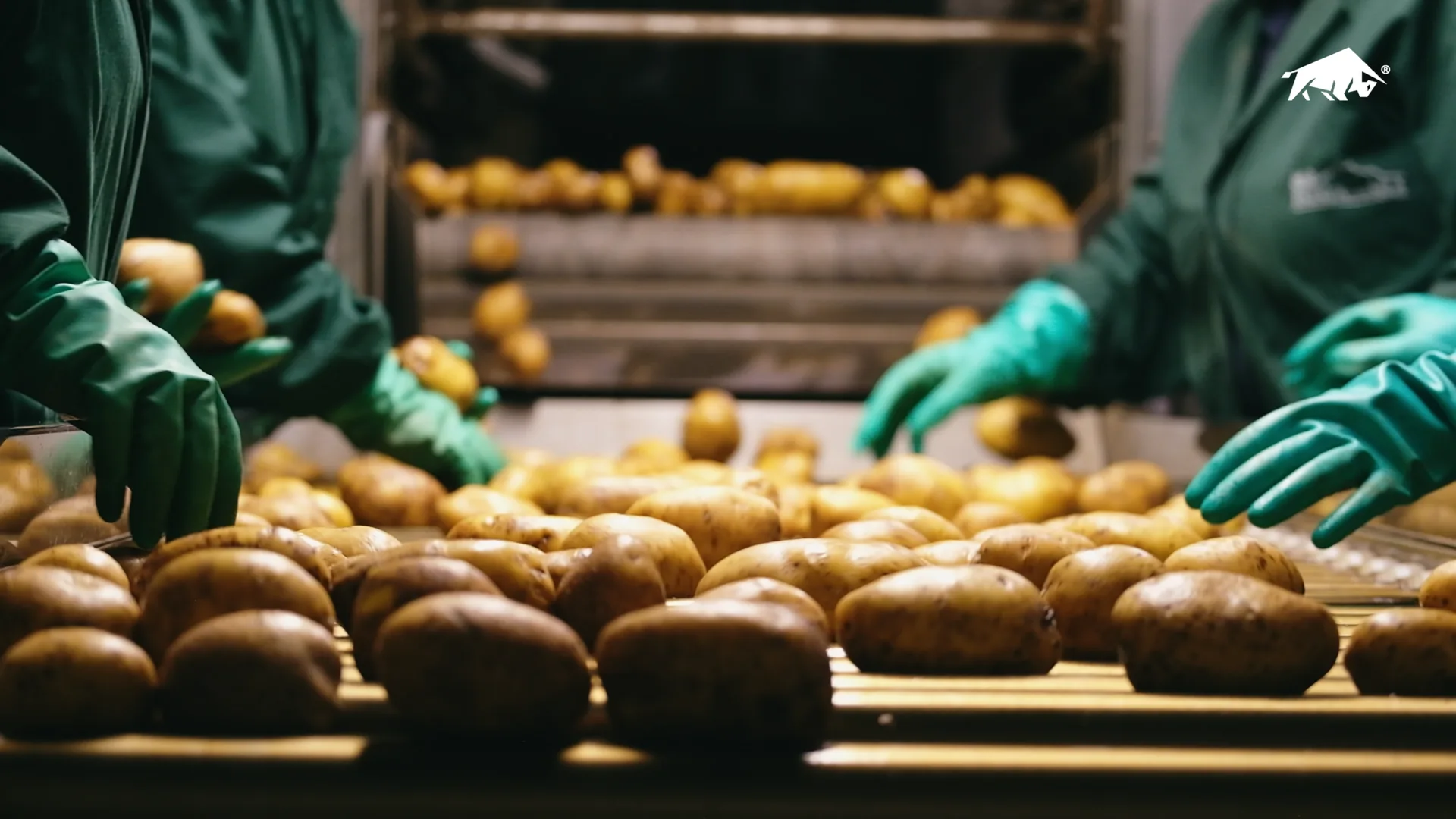
- A potato processing line is an integrated plant that manages the product from reception to packaging, reducing waste, mechanical damage and labor costs.
- The main stages are: reception and bin tipper → handling → cleaning/washing → drying → grading → quality sorting → weighing → packaging.
- Gentleness in handling is the most critical parameter: every uncontrolled free fall translates into bruising, rot and retail returns.
- Correctly sizing the line (tons/h, varieties, degree of soiling, packaging formats) is the difference between a plant that scales and one that creates chronic bottlenecks.
- Bulltec designs electronic weight and dimension grading solutions specific to potatoes, integrable with the rest of the line to guarantee size uniformity, traceability and zero mechanical stress.
1. What is a potato processing line and when is it worth automating
A potato processing line is an integrated set of machines and conveying systems that transforms the raw product—just extracted from storage or the field—into a packaged, graded article ready for distribution. This is not a list of separate machines: it’s a continuous flow where each stage influences the performance of the next.
Why does this concept matter? Because the most common mistake made by plant managers is treating the line as a sum of individual machines rather than as a single system. A very fast grader downstream of inadequate washing produces wet potatoes that bruise during packaging. An automated end-of-line fed by imprecise grading generates systematic overweight. The line’s logic is holistic: every bottleneck multiplies downstream.
When does it make sense to automate?
Automating a potato processing line becomes economically justified in three precise scenarios:
- Volumes above 2–3 tons/h: below this threshold, manual processing with sorting tables can still be competitive in specific contexts. Above this threshold, the hourly cost of labor quickly exceeds the plant’s amortization cost.
- Retail or export standards: modern retail chains impose grading tolerances, absence of visual defects and precise package weight that are practically impossible to guarantee continuously without automated control systems.
- Delicate or high-value-added varieties: new potatoes, baby potatoes, sweet potatoes and fresh-consumption cultivars require a gentleness in handling that only purpose-designed machinery can guarantee consistently.
The Italian market for fresh-consumption potatoes exceeds 800,000 tons annually, with production concentrated in Campania, Apulia, Emilia-Romagna and Sicily. Processing structures with capacity between 5 and 25 tons/h represent the heart of the sector and are the profile for which an integrated line offers the maximum return on investment.
2. Operational stages of the potato line: from reception to packaging
A complete potato processing line is organized into seven sequential stages. Understanding them in detail is the basis for any correct design decision.
Stage 1 – Reception and unloading
The product arrives in 400–1,000 kg bins, in bulk sacks or on pallets. The bin tipper—hydraulic or electric—is the first machine in the line: its job is to feed the potatoes onto the infeed belt with as little trauma as possible. A too-abrupt tipping, with a free fall greater than 15–20 cm, generates micro-lesions in the flesh that turn into browning areas within 48–72 hours. The best modern tippers incorporate controlled-drop deposit systems with rubber deflectors or height-adjustable accompanying belts.
Stage 2 – Dry pre-cleaning and foreign body separation
Before washing, a rotary screen or vibrating table or sieve removes coarse soil, stones and plant residues. This stage reduces the workload of the subsequent washer and protects the pump and brushes from excessive wear. In high-throughput plants, a clod-stone separator is also inserted, which operates by density difference in a water bath.
Stage 3 – Washing
Washing is the most variable stage depending on the degree of soiling of the incoming product.
Possible solutions are:
- roller washer
- soft-brush washer
- immersion and turbulence washer
- or combinations of these
The key parameters are water pressure, product advance speed and brush hardness. Aggressive washing on Kennebec-variety potatoes, for example, can remove the entire surface skin, nullifying commercial value. Process water management—recirculation, soil settling, change frequency—is a parameter often underestimated but crucial for final quality. For a technical deep-dive on parameters, washer types and best practices, see the dedicated guide: Potato washing and cleaning: solutions, parameters and how to reduce damage.
Stage 4 – Drying
Feeding a wet potato into the grader means three problems: incorrect weight reading (the water film adds 5–15 g to each individual tuber), residual soil adhesion to the surface, and risk of slipping in the grading trays with resulting micro-impacts. Drying typically occurs with forced-air belts or soft rubber roller dryers that pat-dry by contact without abrading the skin.
Stage 5 – Grading
Grading is the heart of the line: this is where product value is differentiated. A 250 g potato of 60–70 mm size destined for retail is worth double an identical potato that’s poorly graded and thrown into the industrial sack.
The available technologies are:
- size grading (by diameter/length, with tray machines, drum machines or vision systems)
- weight grading (with an electronic scale for each individual tuber)
Bulltec’s electronic tray graders represent an advanced solution that combines grading precision (±3% on weight, ±3 mm on size) with maximum gentleness in transporting the product: potatoes are accompanied along the entire path without impacts or mechanical stress. For criteria for choosing between different grading technologies, see the deep-dive: Grading and sorting: how to choose the right technology for potatoes.
Stage 6 – Quality sorting
Qualitative sorting occurs in parallel with or downstream of grading and aims to eliminate visual defects: green potatoes (solanine), bruised, cut by the mechanical harvester, with apical rot or excessive deformation. In modern lines, sorting is entrusted to sorting tables with slow-moving belts (for manual sorting) or to machine vision systems capable of classifying surface defects at a speed of 3–5 products/second per channel. The choice depends on the type of market: retail and export require optical sorting; the local market and the processing industry can accept manual table sorting.
Stage 7 – Weighing and packaging
End of line has two objectives in tension with each other: speed and weight precision. The most widespread technological solution for potatoes is the combination weigher (multihead weigher), which combines partial sub-weighings to reach the target with minimal deviation, reducing giveaway (excess weight given away to the customer) to less than 0.5–1%.
Typical packaging formats for fresh-consumption potatoes are:
- net bags of 1, 2, 5 kg
- heat-sealed netting
- MAP trays
- fiber baskets
Batch management, labeling and traceability are natively integrated with the weigher in the most modern solutions. For a complete analysis of end of line, read: Potato packaging: weighing, formats and end-of-line automation.
3. Machines for each stage: from reception to packaging
This section maps the specific machines associated with each stage of the line, with the technical criteria that guide the choice.
Reception and handling
| Machine | Function | Key parameter |
|---|---|---|
| Bin tipper | Bin unloading with controlled drop | Drop height ≤ 20 cm |
| Infeed belt | Transport at adjustable speed | Speed 0.1–0.4 m/s |
| Bucket elevator (specific for fennel) or tray elevator (standard grader with ejectors) | Gentle lifting between levels | Absence of free impact points |
| Buffer hopper | Regulation of incoming flow | Buffer volume 200–500 kg |
The buffer hopper is often underestimated at the design stage: without it, any irregularity in the feed flow translates into gaps in the grader (loss of productivity) or excess accumulation (piles of potatoes bruising each other).
Cleaning and washing
Bulltec’s RG division specializes in integrated solutions for vegetables that include handling and interfacing components with the cleaning stages, ensuring flow continuity between modules.
- Rotary screen: stainless steel drum with calibrated mesh that separates fine soil and light debris before the bath.
- Soft-brush washer: rotating soft polyurethane cylinders that scrub the surface without abrading the skin. Ideal for fresh-consumption potatoes.
- Immersion washer with sonication: for extreme degrees of soiling (sandy potatoes, heavy soils). Ultrasonic agitation also removes interstitial soil.
- Forced-air dryer: tunnel with high-flow fans that remove surface moisture in 30–60 seconds of transit.
Grading and sorting
Grading for potatoes can occur with three main technologies:
- Electronic tray grader (like Bulltec’s solutions): each tuber is transported on an individual tray equipped with a load cell. The software calculates the weight in real time and activates discharge to the corresponding channel. Precision: ±3%. Productivity: up to 2 products/second per channel, with 80% machine load.
- Vision-based dimension grader: high-resolution cameras measure the diameter and length of the tuber in transit. Suitable when volumetric size is the main commercial discriminant (e.g. new potatoes for trays, where visual appearance matters as much as weight).
- Grid or divergent roller grader: simple mechanical technology, suitable for low-throughput lines or rustic products. Lower precision but reduced installation cost.
Weighing and packaging
End-of-line machines include:
- Multihead combination weigher: the most precise for fixed weight targets (±0.5–1% giveaway).
- Automatic bagging machine: for netting and polypropylene sacks, with a speed of 10–20 packages/minute.
- Labeler and batch printer: traceability management, expiration date, EAN code.
- Outfeed belt with metal detector and checkweigher: final check before palletizing.
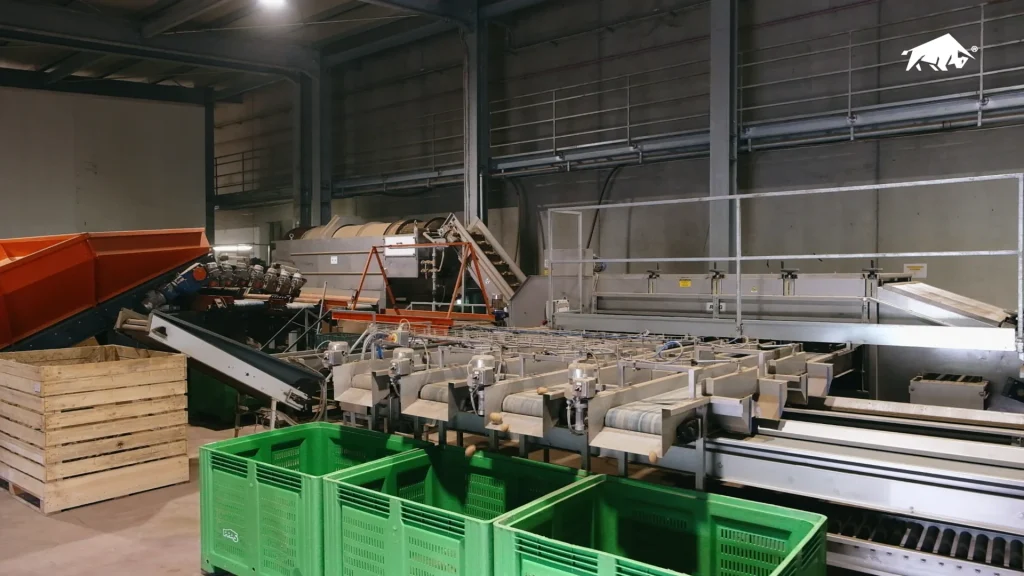
4. How to choose and size the line: throughput, varieties, soiling and formats
Sizing a potato processing line without a precise methodology is the recipe for a plant that’s undersized at the seasonal peak or oversized for actual volumes. Here are the four fundamental design parameters.
Parameter 1 – Throughput (t/h) and seasonal peak
Average throughput is not the correct parameter. Sizing must start from peak throughput: if a company works at 10 t/h for 6 months and 4 t/h for the remaining 6, the line must be designed for 10 t/h. Undersizing to save on capex means creating queues in the bins, operational stress and degraded quality during the main campaign.
The practical rule: add a 20–30% buffer over the nominal throughput to absorb irregularities in incoming flow and unplanned stoppages.
Parameter 2 – Cultivated variety and tuber shape
Tuber shape is decisive for choosing grading technology. Rounded varieties (Agria, Spunta) lend themselves well to both weight grading and dimensional grading. Elongated or irregular varieties (Sieglinde, Ratte) require systems that measure actual volume and not just cross-sectional diameter, otherwise misclassification penalizes larger sizes. For sweet potatoes—a product with a highly irregular shape and particularly sensitive skin—Bulltec has developed specific grading solutions with ultra-gentle handling, as described in the case study on the specific sweet potato grader.
Parameter 3 – Degree of soiling and soil type
Potatoes from heavy clay soil (for example, Campania, Apulia) carry a soil load that can exceed 15% of gross weight. In these cases, dry pre-washing and the immersion washer are indispensable; skipping this stage means soiling the grader in a few minutes and degrading weight precision. Sandy potatoes (e.g. coastal production) have less mud but more fine soil that penetrates the mechanisms: they require greater cleaning frequency and mechanical component protection systems.
Parameter 4 – Packaging formats and commercial mix
A line that must package both 5 kg sacks for retail and 750 g trays for the produce counter has completely different end-of-line requirements compared to a single-market line. The format mix must be defined before choosing the weigher: a multihead combination is optimal for 750 g–2 kg with high speed; a linear auger filler is more suitable for 5–25 kg sacks. Anticipating frequent format changes without fast adjustment systems means stoppages of 30–60 minutes for each change, directly impacting OEE (Overall Equipment Effectiveness).
5. Measurable advantages: waste reduction, quality standards, efficiency and ROI
Adopting an integrated, well-sized potato processing line produces quantifiable benefits across four distinct axes.
Reduction of waste and mechanical damage
A line designed with attention to gentleness—rubberized belts, hoppers with deflectors, controlled drops, individual trays in the grader—reduces visible mechanical damage from the typical 4–8% of more rudimentary lines to less than 1%. In economic terms, on a production of 5,000 t/year at €0.35/kg, the difference between 4% and 1% waste is worth about €52,500 per year in recovered product.
Size uniformity and product value
Electronic weight grading reduces variance in package tare, cutting giveaway (excess weight given to the customer without revenue) from the typical 1.5–3% of manual mechanical bagging machines to less than 0.8%. On significant volumes, every percentage point of recovered giveaway equals additional net income without increasing production.
Operational efficiency and labor reduction
An automated line for 8 t/h typically requires 3–5 employees versus the 12–18 needed for the same volume with manual sorting. Labor savings often cover the plant’s amortization cost in 3–5 years at steady-state shifts.
Traceability and regulatory compliance
Modern weighing and packaging systems integrate batch traceability (EC Reg. 178/2002) with automatic recording of date, time, batch, average weight and standard deviation for each batch. This documentation is today an access requirement for numerous retail channels and for export to northern European and Anglo-Saxon markets.
Estimated ROI
For a 5–8 t/h line with electronic grading, washing, drying and automated end of line, ROI typically sits between 3 and 5 years depending on the number of shifts, product mix and price differential between sizes. Giveaway reduction, waste reduction and labor savings are the three main drivers of the economic equation.
6. Common design mistakes and final checklist
Even the most experienced professionals make predictable mistakes in designing a potato line. Knowing them in advance allows you to avoid them—or diagnose them quickly if the line is already operating.
Mistake 1 – Undersizing the feed buffer
Without an adequate buffer hopper, any irregularity in the bin flow (bins more or less full, product harvested under different conditions) generates throughput variations that destabilize the downstream grader. Rule: the buffer must hold at least 3–5 minutes of steady-state production.
Mistake 2 – Ignoring level changes between stages
Every elevator and every level change introduces a potential impact point. In hastily designed lines, up to 8–12 uncontrolled free falls can be counted between the bin tipper and packaging. On new potatoes or thin-skinned varieties, this is devastating. The golden rule: no free fall greater than 15 cm on non-cushioned product.
Mistake 3 – Neglecting plant hygiene and cleanability
In lines in contact with fresh products, daily sanitation must be fast and complete. Machines with blind corners, unpainted iron supports or hard-to-disassemble belts become hotbeds of bacterial contamination and mold. The correct use of AISI 304/316 stainless steel, rounded corners and removable guides is not an option but a technical requirement.
Mistake 4 – Unscheduled preventive maintenance
A grader with dirty load cells or a weigher with untensioned belts quickly drift toward systematic weight errors. A preventive maintenance program—calibrated to the manufacturer, not to operational impression—prevents silent performance degradation.
Mistake 5 – Rigid layout that doesn’t allow for expansion
Designing the line as a closed island without space to insert an additional stage (e.g. a natural wax polishing pass for premium retail, or a second packaging channel) means having to redo the layout in 2–3 years when commercial needs change.
✅ Potato line design checklist
Use this list as a verification tool before signing a quote or purchase order:
- [ ] Seasonal peak throughput defined and documented (t/h)
- [ ] Variety and morphological characteristics of the tuber specified
- [ ] Average and maximum degree of soiling (% soil/batch) quantified
- [ ] Mix of packaging formats and format-change priorities agreed
- [ ] Free fall heights ≤ 15 cm verified at every point of the line
- [ ] Feed buffer sized for at least 3–5 minutes of production
- [ ] Food-contact materials compliant (AISI 304/316, food-grade plastics)
- [ ] Preventive maintenance plan defined with the manufacturer
- [ ] Batch traceability system integrated with weighing and packaging
- [ ] Physical space provided for potential future expansions
For a complete deep-dive on all stages, also check out the complete guide to potato line stages and machines and evaluate the integrated solutions available in Bulltec’s offering for potatoes.
FAQ — Frequently asked questions about the potato processing line
What are the main stages of a potato processing line?
A complete potato processing line comprises seven sequential stages: reception and unloading (bin tipper), dry pre-cleaning (rotary screen or vibrating sieve), washing (brush, immersion or combined), drying (forced air or soft rollers), grading (weight or size), qualitative sorting (manual or optical) and packaging (combination weighing, bagging, labeling). Each stage is functionally dependent on the previous one: insufficient washing compromises grading, imprecise grading generates giveaway in packaging. Correct design treats the line as a single system, not as a series of independent machines.
What is the difference between weight grading and size grading for potatoes?
Weight grading measures the mass of each individual tuber via a dedicated load cell and sorts the product into weight classes (e.g. <100 g, 100–150 g, 150–250 g, >250 g). It’s the preferred technology when price is determined by the weight of the finished package, as happens in retail. Size grading measures the diameter and/or length of the tuber—typically with camera vision systems—and is more suitable when visual size is the commercial discriminant (e.g. potatoes for plating in catering, baby potatoes). For irregular or elongated varieties, size grading can overestimate actual size; that’s why many modern lines combine both technologies. Bulltec offers electronic tray graders with ±3% precision on weight and ±3 mm on size, configurable based on the product and destination market.
How many t/h can an automated potato processing line handle?
The throughput of a potato processing line ranges from less than 2 t/h for semi-artisanal plants to over 25 t/h for large industrial structures. Most mid-range Italian plants work between 5 and 15 t/h. Actual throughput depends on the configuration of each individual machine, the quality of the incoming product (degree of soiling, waste percentage) and the number of sizes to be managed simultaneously. Correct sizing must always refer to seasonal peak throughput, not annual average, and include a 20–30% buffer to absorb operational variability.
How can the risk of bruising and mechanical damage on the line be reduced?
The risk of mechanical damage is reduced by acting on three levers simultaneously: (1) control of drop heights—no point on the line should have free falls greater than 15 cm onto non-cushioned surfaces; (2) soft contact surfaces—soft rubber belts, polymer material trays, polyurethane deflectors instead of bare steel; (3) calibrated transit speed—moving the product too fast increases the kinetic energy of impacts. Bulltec’s tray graders are designed with specific attention to gentleness: each potato is accompanied individually along the path, with no free bouncing between channels.
How long does it take to amortize the investment in an automated potato line?
The ROI of an automated potato processing line depends on three main variables: number of annual operating hours, labor savings (3–5 fewer employees compared to manual sorting) and product value recovery (waste reduction, giveaway reduction, access to premium retail channels). For a 5–8 t/h line at steady state over two daily shifts, the typical payback period is 3–5 years. Plants with high seasonality (6 months/year) tend toward the upper limit; those with a longer season or significant product value enhancement (e.g. new potatoes for retail) approach 3 years. The calculation must also include savings in terms of customer returns (less damaged product = fewer non-conformities).
Is the potato processing line the same for sweet potatoes?
No. Sweet potatoes require specific adaptations compared to common potatoes, mainly for three reasons: (1) the shape is much more irregular and elongated, which makes standard mechanical grading systems unsuitable; (2) the skin is significantly more fragile and prone to abrasion, which requires ultra-soft contact surfaces and reduced handling speeds; (3) the product is more sensitive to thermal fluctuations during drying. Bulltec has developed a dedicated grading solution for sweet potatoes, described in detail in the case study A very gentle grader specific for sweet potatoes, which adapts both the tray geometry and the handling parameters to preserve tuber integrity throughout the entire cycle.
What packaging formats are compatible with a potato processing line?
The most common packaging formats for fresh-consumption potatoes are: net or polypropylene sacks of 1, 2, 2.5 and 5 kg (the dominant format in Italian retail), heat-sealed netting for premium packages, MAP (Modified Atmosphere Packaging) trays of 400–1,000 g for baby potatoes and new potatoes, and bins of 10–25 kg for institutional catering. Each format requires a specific packaging machine (bagging machine, heat sealer, tray thermoformer) connected to a compatible weigher. The choice of format mix is one of the most impactful design parameters on the entire end-of-line architecture. For technical details on packaging, visit: Potato packaging: weighing, formats and end-of-line automation.