
- Industrial potato washing is organized into distinct stages — dry pre-cleaning, destoning, washing with brushes/water, drying — each with precise parameters to respect.
- The choice between dry cleaning and water washing depends on the degree of soiling, the product’s destination and the available layout: there is no universal solution.
- The key parameters to control are: water flow, nozzle pressure, brush rotation speed, contact time and temperature.
- Proper drying after washing is essential to avoid moisture-related bruising, rot problems and inaccuracies in the subsequent grading and packaging stages.
- Integrating the washing module into the potato processing line with correct engineering criteria reduces waste and improves downstream product quality.
Why industrial potato washing is the most critical stage of the line
Imagine processing 10 tons of potatoes per hour directly from the field. Compacted crusted soil, fine sand between the skin’s grooves, stone fragments and plant residues: this is the starting point. If the industrial potato washing stage is undersized or poorly configured, everything that comes after — grading, sorting, packaging — suffers the consequences in terms of quality, yield and commercial shelf life of the product.
Washing and cleaning potatoes on the line isn’t simply “wetting potatoes with water”. It’s an engineering sequence of stages that must balance cleaning effectiveness, mechanical gentleness and operational sustainability (water consumption, wastewater management, maintenance). Understanding this logic is the prerequisite for correctly sizing the plant.
Within the complete guide to potato line stages and machines, the washing module occupies a central position: it receives the raw product from reception and delivers it clean — and dry — to grading.
The stages of potato washing on the line: from pre-cleaning to drying
Industrial potato washing is typically organized into four sequential macro-stages, each with specific functions and machines. A well-designed line integrates them into a continuous flow, without accumulation and without free falls that can generate bruising.
Stage 1 — Dry pre-cleaning: the first barrier against heavy soiling
Dry pre-cleaning is stage zero of the process: its purpose is to remove loose soil, small stones, coarse plant residues and light foreign bodies before contact with water. Why is it important to do this dry? Simple: bringing large amounts of soil into the washing tank quickly saturates the water and reduces its effectiveness, increases the volumes of muddy wastewater to manage and consumes resources unnecessarily.
The machines used in this stage are typically:
- Rotary screens or drum cleaners: a perforated cylinder that rolls potatoes, removing fine debris
- Vibrating tables with calibrated grids: vibration separates soil without mechanically impacting the product
- Dry rotating brushes: effective for varieties with resistant skin, less suitable for new potatoes or thin-skinned ones
The key parameter of this stage is the peripheral speed of the drum or brushes: too slow → insufficient cleaning; too fast → abrasions and micro-tears in the skin.
Stage 2 — Destoning and stone separation: protecting downstream machines
Destoning is a stage often underestimated in plant projects. Stones, even small ones, can seriously damage the washer’s brushes, conveyor belts and the mechanical parts of graders. The most widespread operating principle is the controlled water-flow tank (wet destoner): potatoes, lighter, float or move with the flow, while stones, denser, settle at the bottom and are mechanically removed.
The parameters to control in wet destoning are:
- Incoming water flow (defines the flow speed and drag capacity)
- Channel inclination (affects contact time and separation effectiveness)
- Frequency of stone drawer emptying (often automated on high-throughput lines)
Effective destoning is the precondition for productive washing and for the longevity of all downstream machines.
Stage 3 — Washing with water and brushes: the heart of the process
This is the stage that justifies the term “industrial potato washing” in the strict sense. The product enters a washing tank or tunnel where it’s subjected to the combined action of water and rotating brushes. The two process variables that determine the final result are closely interdependent.
Types of industrial washers:
| Type | Principle | Typical throughput | Strengths |
|---|---|---|---|
| Drum washer | Rotation in a water tank | 5–30 t/h | Robustness, effectiveness on heavy soiling |
| Roller/brush washer | Rotating brushes + cascading water | 3–20 t/h | Gentleness, precise skin cleaning |
| Immersion + spray washer | Immersion + high-pressure nozzles | 2–15 t/h | Deep cleaning of grooves, flexibility |
Critical operational parameters to monitor:
- Spray nozzle pressure: generally between 1.5 and 4 bar for standard washing ; higher pressures risk lifting or tearing the skin
- Brush rotation speed: expressed in rpm, must be calibrated to the skin hardness of the variety being processed (a russet tolerates more abrasion than a new potato)
- Water temperature: lukewarm water (15–20°C) favors detachment of clay soil, but requires greater attention to microbiological control
- Dwell time in the tank: variable between 30 and 120 seconds depending on the initial degree of soiling
- Water exchange: fundamental for maintaining effectiveness over time ; water that’s too turbid doesn’t wash, it spreads dirt
For potatoes with particularly delicate skin — such as some new varieties or sweet potatoes — it’s preferable to reduce spray pressure and use soft-material brushes (nylon or silicone), adopting an approach similar to that described for the high-gentleness solutions developed by Bulltec.
Stage 4 — Drying: the final step that determines downstream product quality
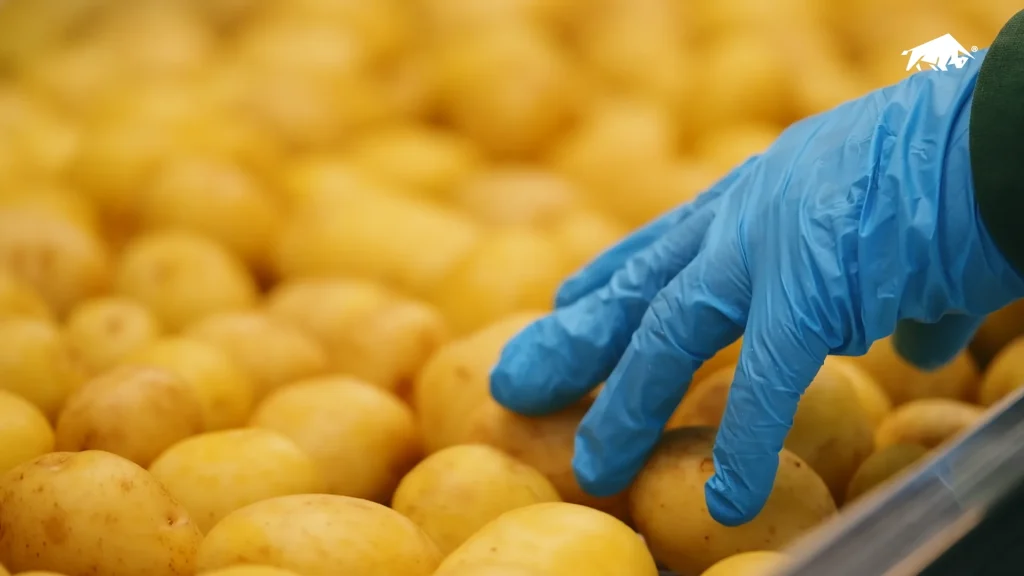
Washed potatoes are wet.
This seems obvious, but the operational consequences of neglecting this stage are far from trivial:
- Bruising and mechanical damage: wet skin is more fragile and prone to micro-lesions from impact on belts, in hoppers and on line guides
- Grading inaccuracies: surface water adds variable weight, altering weighing and distribution into size classes
- Storage problems: moist product in a closed package develops bacterial and fungal rot up to 3–5 times faster than dry product
- Labels that don’t adhere: in lines with direct packaging, moisture is the enemy of self-adhesive labels
Drying technologies used in industrial potato lines include:
- Absorbent rollers (sponge or microfiber material): the most widespread solution for gentleness and contained plant costs
- Controlled hot-air dryers: more effective but with higher energy consumption, suitable for high-throughput production
- Forced ventilation tunnels: ideal for lines with low ambient humidity, where air circulation alone is sufficient
Dry cleaning vs water washing: when to choose one or the other
One of the most frequent questions in designing a potato line is: is it necessary to wash, or is dry cleaning enough? The answer depends on four determining factors.
Factors guiding the choice
- Commercial destination of the product — Potatoes destined for retail in transparent packages — net sacks, flow-pack trays — almost always require complete washing: the end consumer wants to see a visually clean product. Conversely, bulk potatoes destined for the processing industry (chips, starch, frozen) can sometimes proceed with only dry cleaning, since they’ll be washed anyway in the customer’s industrial process.
- Type and amount of soiling — Sandy-silty soils are well removed with dry cleaning followed by light washing. Heavy clay soils, which crust onto the skin, require intensive water washing. As a practical rule: if the soil falls off on its own at first contact with dry brushes, pre-washing is sufficient; if it remains adherent, water is needed.
- Variety and phenological stage — New potatoes have skin that’s not yet perfectly formed (surface peeling): aggressive washing leads to partial peeling, with associated darkening and quality decay. For these varieties, a low-pressure, high-gentleness approach is preferred. Sweet potatoes, for example, require even more conservative configurations given the particular fragility of their skin.
- Water availability and wastewater management — Every ton of washed potatoes generates between 0.5 and 1.5 m³ of wastewater with a high solids load. Where water is a critical resource or purification costs are high, it makes sense to maximize the effectiveness of dry cleaning to reduce the water requirement of subsequent washing.
Decision summary table:
| Condition | Dry cleaning | Water washing |
|---|---|---|
| Retail, transparent packages | ✗ insufficient | ✓ necessary |
| Processing industry | ✓ acceptable | ○ optional |
| Heavy clay soil | ✗ insufficient | ✓ necessary |
| New potatoes, fragile skin | ✓ preferable | ○ gentle only |
| High throughput (>15 t/h) | ✓ in combination | ✓ in sequence |
Process parameters and KPIs for optimal cleaning
Knowing the stages isn’t enough: parameters must be measured and controlled to ensure process consistency and product quality. The KPIs (Key Performance Indicators) of a well-configured potato washing module are:
Operational parameters to monitor continuously
- Tank water turbidity (NTU): beyond a certain threshold (indicatively > 500 NTU for standard washing) water exchange is necessary
- Percentage of potatoes with soil residue after washing (target: < 2% in the finished product)
- Rate of process-induced bruising and abrasions (sample visual inspection every 30–60 minutes)
- Water consumption per ton processed (industry benchmark: 0.8–1.2 m³/t in well-optimized plants)
- Water temperature (automatic monitoring with a PT100 probe integrated in the tank)
Warning signs not to ignore
- Output product still with localized soil stains → check nozzle pressure or belt speed
- Anomalous increase in waste due to bruising → reduce brush rotation speed or lower throughput
- Increasing water consumption without production changes → possible exchange valve fault or leak
- Pungent odor from tank water → bacterial proliferation, need for biocidal treatment and complete exchange
Integration with the line: how washing conditions grading and packaging
The potato washing module doesn’t operate in isolation: it’s a critical node in the chain from reception to packaging. Its performance directly conditions downstream stages.
The link with grading
A wet potato carries additional variable weight (from 5 to 20 grams depending on size). If the grader operates by weight, this systematic error is transferred to the precision of the size classes, resulting in increased waste and rework. The solution is to ensure effective and uniform drying before entering the grader, whether it’s a tray machine like Bulltec’s Electronic Tray Graders, or an alternative solution. To explore the criteria for choosing grading technology, see the guide on grading and sorting: how to choose the right technology for potatoes.
The link with packaging
Moist product in packaging generates two immediate problems: internal condensation (which accelerates microbiological decay) and difficulty with label adhesion. For those managing lines with net sacks or heat-shrink film, residual moisture is literally the number one enemy of shelf life. Drying to specification reduces retail returns and improves the qualitative perception of the product. Final packaging — with its weighing and automation requirements — is detailed in the guide to potato packaging: weighing, formats and end-of-line automation.
The role of the RG Division in the integrated project
Bulltec, through its RG Division, offers integrated expertise for designing complete lines where the washing module is sized and positioned according to the entire production sequence. This “system” approach — rather than purchasing individual machines to assemble later on one’s own — ensures that the washer’s throughput is consistent with that of the grader and packaging, avoiding the classic bottlenecks that arise when individual modules don’t “talk” to each other.
Operational best practices and maintenance of the washing module
The best washing machine is worth nothing if it’s not properly maintained. Here are the established best practices that distinguish professional operators from beginners.
Daily checklist for line operators
- [ ] Visual check of brush integrity (wear, deformation, breakage)
- [ ] Check of incoming water flow (flowmeter or volumetric measurement)
- [ ] Cleaning of the stone collection basket in destoning
- [ ] Check of tank water turbidity and decision on exchange
- [ ] Check of drying at output (sample of 20 potatoes by hand: they must be dry to the touch)
- [ ] Lubrication of bearings and transmission components according to the manufacturer’s maintenance plan
Seasonal best practices
- At the start of the campaign: replace worn brushes, check the hydraulic seal of all connections, recalibrate nozzle pressure
- During the campaign: increase the frequency of turbidity checks (every 2 hours on intensive production)
- At the end of the campaign: complete system washing with a food-grade approved biocidal solution, disassembly and cleaning of the brushes, structural inspection of the tank
Water management: efficiency and regulatory compliance
Water management is one of the most regulated aspects in fruit and vegetable processing lines. Wastewater from the potato washing stage contains soil, sand, organic residues and, in some situations, traces of pesticides. European regulations (in particular EC Regulation 852/2004 on food hygiene) require that water in direct contact with the product be potable. Controlled recirculation is permitted but must respect turbidity and bacterial load limits. A well-designed sedimentation + recirculation system can reduce water consumption by 40–60% compared to a single-use plant.
FAQ — Frequently asked questions about industrial potato washing
What is the difference between dry cleaning and wet washing of potatoes?
Dry cleaning uses vibration, mechanical rotation and brushes without water to remove loose soil, dust and coarse debris from the surface of potatoes. It’s the first stage of a gradient system, indicated especially for product destined for the processing industry or for sandy-silty soils. Wet washing adds the action of water — in a tank or by spraying — to remove residual dirt, crusted clay and fine impurities. The choice between the two approaches depends on the commercial destination of the product, the variety being processed and the type of source soil. In many advanced industrial lines, a sequential combination is used: dry pre-cleaning → destoning → wet washing.
How much water does an industrial potato washing line consume?
Water consumption depends on the type of plant, the amount of soiling and the presence or absence of recirculation systems. A plant without recirculation consumes on average between 0.8 and 2 m³ of water for each ton of potatoes processed. With optimized sedimentation and recirculation systems, this can drop to 0.3–0.5 m³/t. The most modern high water-efficiency lines integrate settling tanks, sand filters and continuous turbidity monitoring systems, reducing both consumption and wastewater disposal costs.
Do the washer’s brushes damage potato skin?
If configured correctly, no. The risk of mechanical damage (abrasions, micro-tears, partial peeling) exists but is controlled with three variables: the type of brush material (soft nylon for delicate varieties, rigid polypropylene for potatoes with robust skin), the rotation speed (to be calibrated to the variety) and the contact time (dwell time in the machine). New varieties and sweet potatoes require specific, conservative adjustments, with reduced pressures and soft-material brushes. Empirical verification is simple: take a sample of 50 potatoes after washing and inspect them under raking light; if abrasions or lifted skin areas are noticed, the parameters need to be corrected.
When is it necessary to dry potatoes after washing?
Post-washing drying is always necessary in an industrial line that includes weight grading and/or direct packaging. Wet potatoes alter the weighing of electronic graders, create condensation problems in closed packages, favor the development of pathogens (particularly Erwinia spp. and Fusarium spp.) and prevent proper label adhesion. The only partial exception concerns products destined immediately for industrial processing (cooking, mechanical peeling) where preventive drying can be omitted. In all other cases, it’s an investment that pays for itself in product quality and reduced commercial returns.
How does the washing module integrate with the tray grader?
Optimal integration between washer and grader includes a drying/transit belt of sufficient length to ensure the product arrives at the grader’s infeed with surface moisture below 2–3% (practical assessment: dry to the touch). This belt must have a slope and profile that don’t generate impacts or free falls. The belt’s throughput must be synchronized with that of the grader to avoid accumulation or gaps in product, which generate mechanical overpressure and process discontinuity respectively. Bulltec offers integrated solutions designed for the potato sector, including Electronic Tray Graders designed to minimize impacts and ensure maximum gentleness on the product.
To explore all stages from reception to packaging, see the complete guide to the potato processing line. For details on packaging, read the article on potato packaging: weighing, formats and end-of-line automation. For Bulltec solutions dedicated to potatoes and sweet potatoes, visit the relevant product pages.