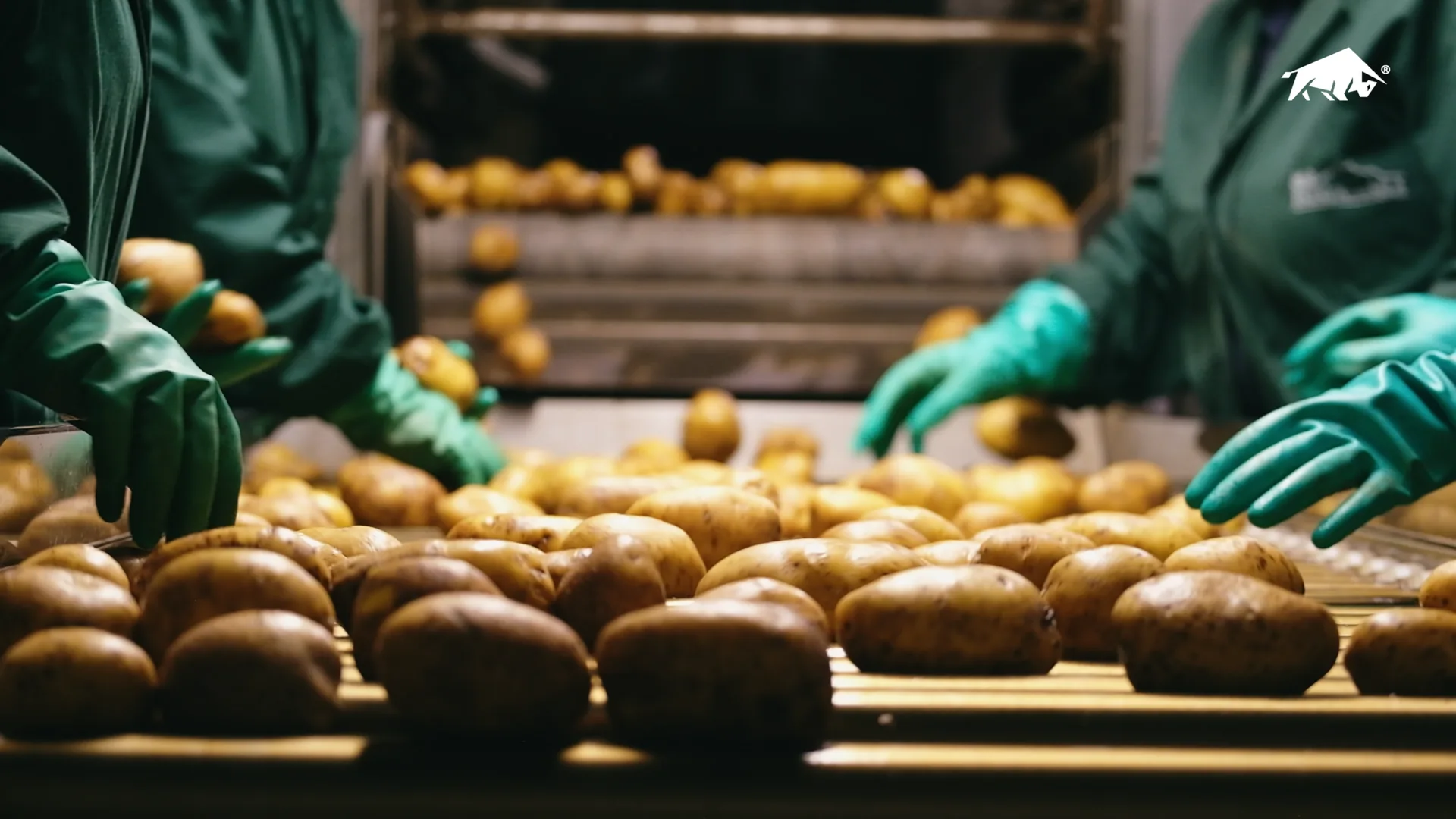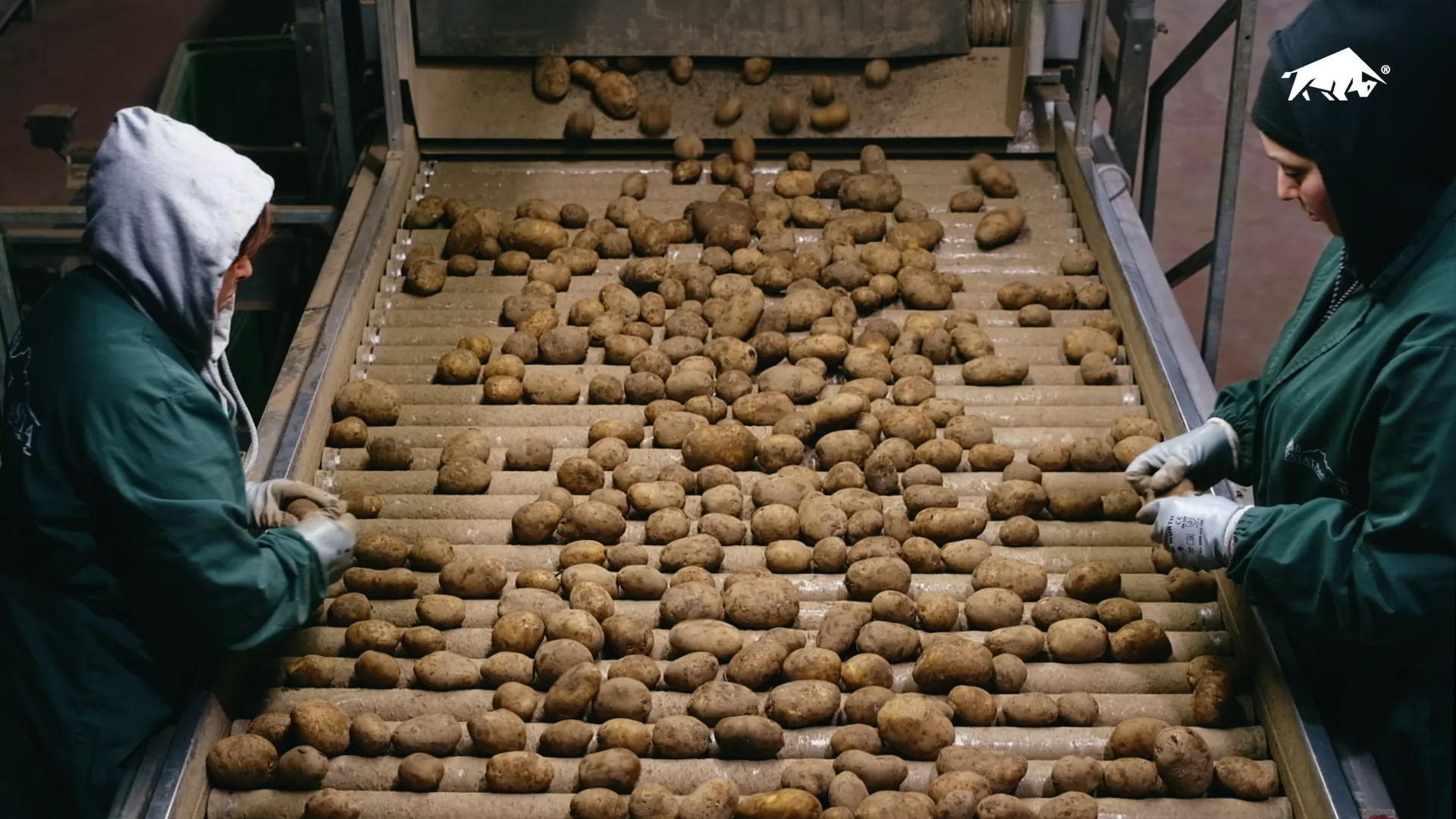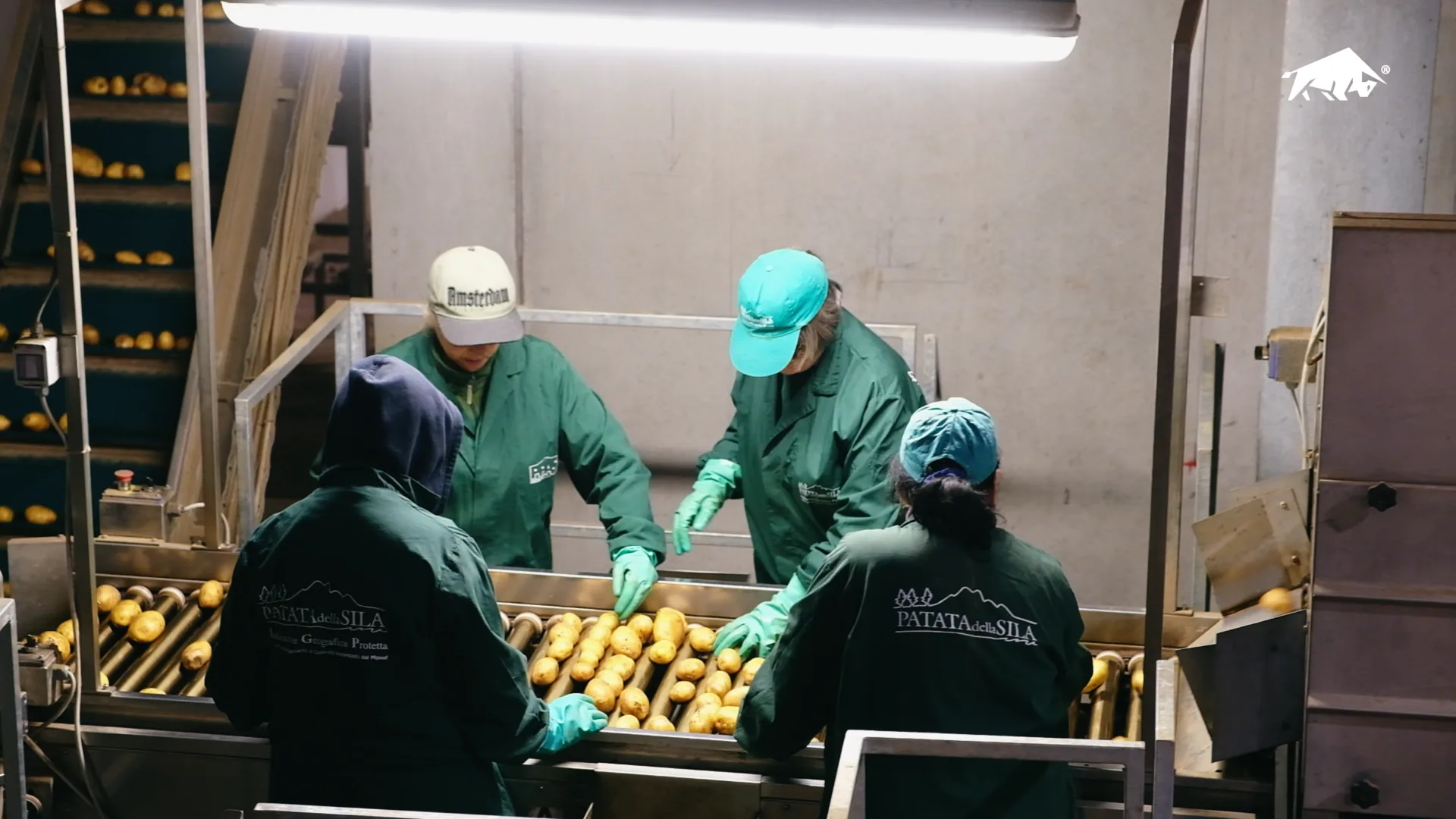

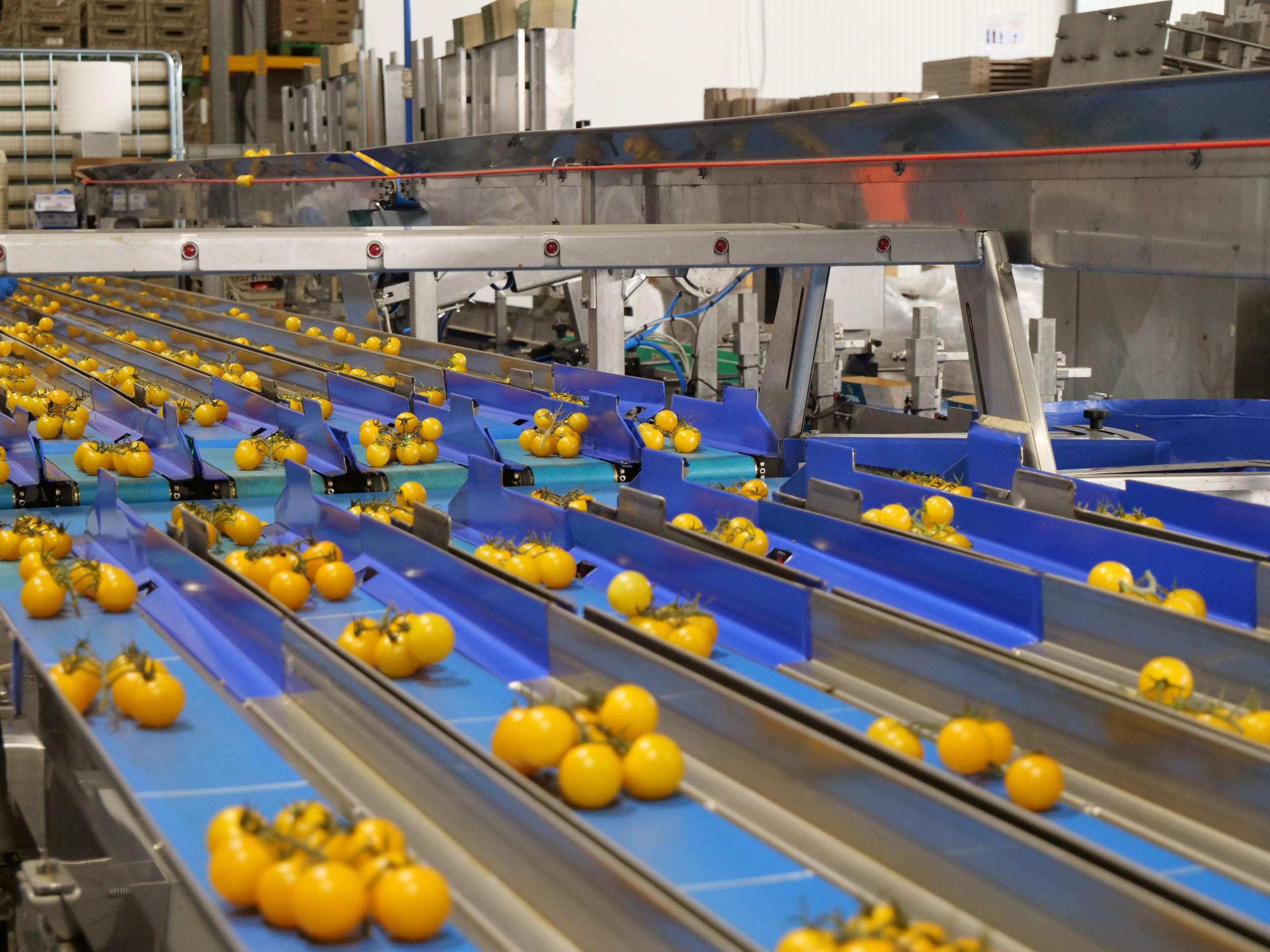
- Fruit and vegetable post-harvest automation is the set of machines, software and methods that stabilize flow, quality and traceability from reception to the pallet.
- The value is concentrated where you currently have bottlenecks, avoidable waste and weight giveaway (overweight in the package), as well as downtime and slow format changes.
- Before “buying robots”, measure: OEE, waste, productivity (kg/man/hour), giveaway, complaints and recipe/format change times.
- The key technologies: conveying and buffers, calibration/sorting, combination weighing, labeling, and data integration (batches, weights, waste, pallets).
- ROI improves when automation is designed as a line system (layout + synchronization + sanitation + data), not as a single machine.
What post-harvest processing in fruit and vegetables is and where automation generates the most value
Fruit and vegetable post-harvest automation is the design and implementation of an integrated system (mechanics + industrial automation + quality control + data management) that transforms a variable and fragile flow—the fresh product—into a stable, measurable and traceable flow ready for sale (packaging, labels, logistics units).
In practice, “post-harvest” includes all activities between:
- Product arrival (bins, crates, pallets, trucks),
- Preparation (unloading, washing, drying, pre-cooling when present),
- Sorting and grading (weight, size, defects, category),
- Packaging (trays, flowpack, netting, cartons, RPC),
- End of line (checks, labeling, palletizing),
- Shipping (finished pallets and documentation).
Where automation truly “pays off”
Automation creates value when it impacts economic and commercial KPIs, not just “speed”. The typical high-return points are:
Labor reduction at repetitive and strenuous points
Unloading, line feeding, filling, end of line and palletizing are often activities with high cost incidence, with variable staff availability (seasonality).
Quality standardization and complaint reduction
More consistent grading and sorting systems reduce the “operator-dependent” effect and make standards replicable.
Reduction of waste and rework
Waste generated by impacts, jams, inconsistent settings, long dwell times in “uncontrolled” buffers can be reduced with a smoother, more regulated flow.
Reduction of weight giveaway
In fixed-weight packaging, the inefficiency is often invisible: it’s the average overweight used to avoid underweight. Improving weighing and control means immediate margin.
Traceability and data: from “compliance” cost to operational lever
If data is collected properly (batches, yields, waste, weights), it becomes a tool to optimize yields and planning, not just for audits.
If you want to explore further how to turn automation into a “line” project (rather than a single-machine one), you’ll find a dedicated guide on designing post-harvest lines without bottlenecks.
Fruit and vegetable post-harvest automation: the line stages (from reception to end of line)
Let’s break down a typical line into stages. The goal is not to automate “everything”, but to understand where flow, quality and data control are needed.
Reception and unloading: from truck to a “manageable” flow
This is often where the fate of the entire production day is decided.
Automation goals at reception
- Avoid unmanageable peaks (trucks queuing → rushed unloading → damage and mixing).
- Correctly associate the incoming batch with supplier/field/variety.
- Feed the line with a stable flow (kg/min or pieces/min).
Typical solutions
- Roller conveyors and transport for crates/pallets, bin unloading systems, dosing units and hoppers with level control.
- Incoming scales for gross weights/tares (when management logic requires it).
- First batch identification (barcode/QR on document or bin label).
Common mistake: automating unloading without providing a “buffer” between reception and processing. Result: the line stops at the first micro-blockage.
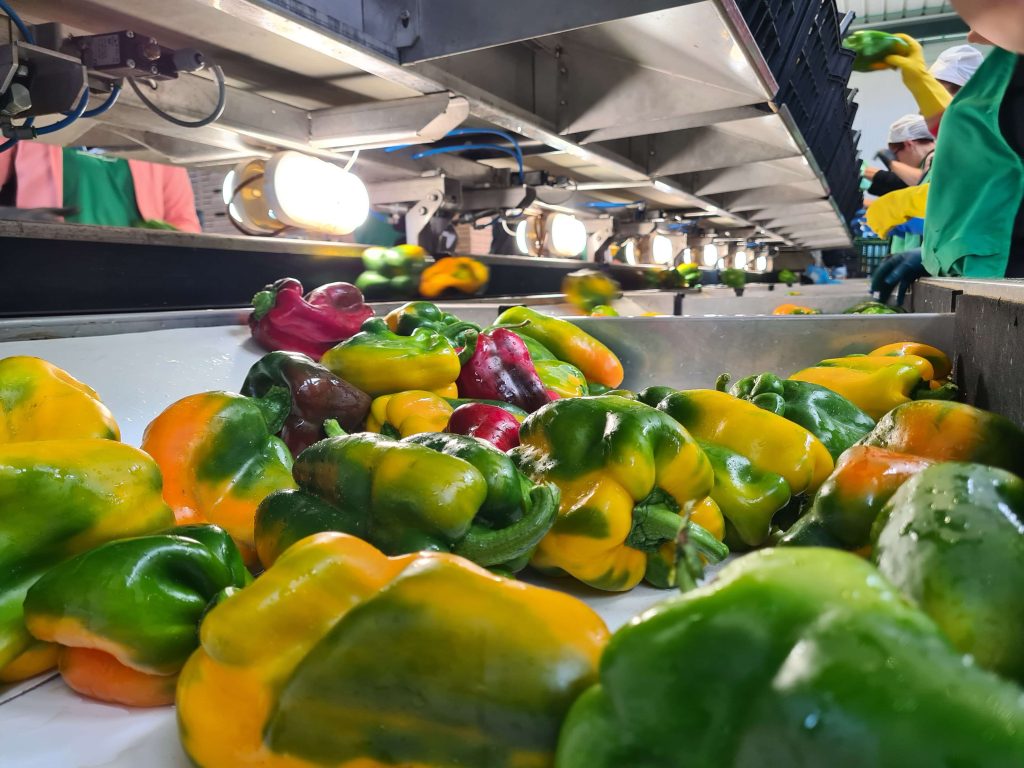
Pre-processing: washing, brushing, drying (when present)
Not all product requires washing, but when it does, this section affects:
- hygiene,
- commercial appearance,
- process stability (water + residues = jams).
Goals
- Repeatable cleaning and controlled parameters (water flow, pressure, brush speed, recipes per product).
- Minimize mechanical damage and dwell times.
- Facilitate sanitation (HACCP).
Automation best practices
- Level and turbidity sensors where sensible, recipe management, pressure/flow alarms, safety interlocks.
- Design for cleaning: accessible surfaces, drains, suitable materials, washable guards.
Grading and sorting: the “economic” heart of post-harvest
This is where “value is created” because it’s decided what becomes first choice, second choice, industrial, waste—and in which size or weight range.
Grading can mean:
- by size (diameter/volume),
- by weight,
- by category (external defects, color, shape).
For certain specific applications, solutions such as electronic tray graders or product-specific vertical machines (e.g. electronic fennel graders) are central, helping to turn an irregular flow into class-controlled outputs.
If your priority is reducing waste and complaints with measurable criteria, look further into quality sorting with machine vision in fruit and vegetables.
Packaging: weighing, forming saleable units, avoiding overweight
Packaging is often where margin is “burned” through giveaway.
Goals
- Reach target weight with minimal variance.
- Reduce stoppages due to lack of product or accumulation.
- Manage multiple formats (trays, bags, netting, cartons) with fast changeovers.
Key technologies
- Combination weighing and dosing systems: for example combination weighing and smart combination weighing (typical choices when the priority is to increase precision and speed in portioning).
- Weight control (checkweigher) and waste management (underweight/overweight).
- Labeling and variable data printing (batch, PLU, weight, origin, date).
End of line: control, labeling, palletizing
This is the section where speed is “paid for” in space and synchronization.
Goals
- Stable pack closure (tape, glue, strapping).
- Correct and legible label (even in humid/cold environments).
- Palletizing consistent with logistics logic (pallet mix, heights, weights, destinations).
Strategic note: automating palletizing makes sense when:
- volumes are sufficient,
- packaging standardization is good,
- maneuvering and safety spaces are adequate.
KPIs and bottlenecks: how to measure efficiency (OEE, waste, giveaway, productivity)
Automating without measuring is like “accelerating without a speedometer”. Below are the KPIs that really matter for deciding what to automate first.
Essential KPIs (with operational definitions)
OEE (Overall Equipment Effectiveness)
Synthetic measure of the effectiveness of a line or station:
- Availability = running time / planned time
- Performance = actual speed / rated speed
- Quality = good pieces / total pieces
OEE = Availability × Performance × Quality
In post-harvest, “Quality” is not just mechanical defects: it also includes waste generated by the process (damage, incorrect sorting, rework).
Waste and yield
- Waste % = waste / input
- Yield % = saleable product / input
Yield should be read by category (first/second choice/industrial), because automation often changes the distribution, not just the total.
Weight giveaway (average overweight)
In fixed weight (e.g. 1 kg), if packages average 1.03 kg, the giveaway is 30 g. Over large volumes this is a huge and often invisible cost.
Labor productivity
kg/man/hour or packages/man/hour Useful for comparing before/after scenarios and for sizing seasonal shifts.
Micro-stops and format changes
Time lost due to jams, unplanned cleaning, lack of material, adjustments. In fruit and vegetables, micro-stops are often more significant than major breakdowns.
Practical method: finding the bottleneck before investing
Use this sequence (simple but effective):
- Draw the real flow (not the “design” one) : From reception to pallet, including operators, carts, crossings, accumulation points.
- Measure 5 variables per station for 1–2 weeks: average and peak throughput, downtime minutes (with cause), waste generated, staff employed, recipe/format change times.
- Calculate the effective capacity of each station : Rated capacity is useless if you then stop due to jams or lack of feed.
- Identify the constraint (Theory of Constraints) : The bottleneck is the station that, under real conditions, limits output. Automating elsewhere increases WIP (work in progress), not revenue.
- Estimate the system effect : Every upgrade must include buffer and synchronization: if you upgrade the grader but not the packaging, you create accumulation and damage.
If you want a more “plant-level” framework (layout, sizing of conveyors and buffers, OEE and micro-stops), refer to the guide on designing fruit and vegetable post-harvest lines.
Key technologies: conveying, buffers, weighing, robotics, vision, labeling
This is the section where many pages stay generic. Here instead the goal is: which technology solves which problem.
Conveying and “gentle” product handling
In fruit and vegetables, handling is not a detail: it is saleable quality.
Technologies
- Modular belts, roller shutter belts, roller conveyors, elevators, accumulation tables.
- Low-drop solutions (reduced drops), guides and conveyors designed to minimize impacts.
When it’s a priority
- If you have mechanical damage, bruising, cuts, abrasions.
- If stoppages result from jams or product returns.
Buffers and accumulation: the flow’s “safety belt”
The buffer is not waste: it is control of variability.
Buffer types
- In-line accumulation (tables, accumulation belts).
- Reservoirs between sections (between sorting and packaging).
- Packaging buffers (cartons, film, labels) with minimum stock signaling.
Benefits
- Reduction of cascading stoppages.
- Better utilization of the most expensive station (often grading/vision/weighing).
Weighing: dosing, combination and weight control
This is where you win on giveaway.
Approaches
- Simple dosing (cheaper, less precise).
- Combination weighing (more precise and faster on target-weight packages, especially with a size mix).
If you’re evaluating specific solutions, explore combination weighing and smart combination weighing options as typical components of a line where the goal is to maximize precision and repeatability.
Indicators that “you’re ready” for a combination system
- High average overweight to avoid underweight.
- Products with size variability.
- Demand for multiple formats/target weights in the same day.
Machine vision and classification: what to really measure (and what not to)
Machine vision is useful when the cost of non-quality (complaints, returns, downgrading) exceeds the cost of the system and its management.
What can often be measured
- Dimensions/volume
- color
- external defects
- shape
- uniformity
What requires caution
- Non-visible internal defects (unless using specific techniques such as NIR or X-rays, not always justified).
- “Sensory” ripening: can be estimated with proxies (color, texture), but requires calibration by variety and season.
For criteria, limits, settings and impact on yield and complaints, see sorting and classification with machine vision.
Labeling and identification: print-and-apply, codes and compliance
The label is “the last mile” before the customer. Errors here = returns and non-compliance.
Typical components
- Print and apply on cartons or film.
- Barcode/QR readers for verification (vision check or scanner).
- Variable data management (batch, weight, origin, size, line, shift).
Robotics: where it makes sense (and where it doesn’t)
Robotics in fruit and vegetables is not just “an arm instead of the operator”. It must be:
- compatible with the environment (humidity, washing),
- safe and integrated with the layout,
- fed by a stable flow.
Applications with more common ROI
- Palletizing of standardized cartons/RPCs.
- Pick&place of rigid packages when variability is managed (orientation, distances, speed).
More complex applications
Direct handling of loose product: possible, but requires great care (grippers, suction cups, speed, damage).
Integration and layout: retrofit vs new line, format changes, sanitation and safety
If technology is “the engine”, layout is the chassis. A post-harvest plant works when mechanics, automation and procedures are consistent.
Retrofit or new line? A simple decision rule
Retrofit (integration onto existing equipment) is worthwhile when:
- the structure and spaces are adequate,
- you have localized bottlenecks (e.g. weighing or end of line),
- you want to improve OEE without stopping production for months.
A new line is worthwhile when:
- current logistics flows are chaotic (crossings, returns, tight spaces),
- you need to significantly increase capacity,
- you want to introduce end-to-end traceability and don’t have reliable databases.
In both cases, the typical mistake is underestimating:
- space for buffers,
- maintenance and cleaning access,
- people/cart routes (safety and hygiene).
Format changes and “recipes”: how to reduce downtime
In fruit and vegetables, seasonality drives many batches and fast changeovers. Automation must include:
- line recipes (belt speed, sorting settings, target weight, label parameters),
- guided adjustments (HMI with checklist),
- quick-release components and mechanical references for repeatability,
- sensors for auto-setting and component presence control.
Recommended KPI: minutes per “good” format change (first compliant package). This is more useful than simple downtime.
Hygiene, sanitation and HACCP: automation compatible with cleaning
Automating in a food environment means designing for:
- ease of cleaning,
- reduction of stagnation areas,
- suitable materials and finishes,
- protection of electrical components (IP rating, positioning, cable ducts).
Hygiene checklist (practical)
- Sloped surfaces and drains where possible.
- Quick access to residue accumulation areas (under belts, hoppers, brushes).
- Standard cleaning procedures (SOPs) integrated into cycle times.
- Separation of dirty/clean areas (reception vs packaged).
Machine safety and compliance (briefly, but concretely)
Every automation intervention must consider:
- guards, photocells/barriers, emergency stop buttons,
- risk assessment and lockout/tagout procedures,
- training of operators and maintenance staff.
Good automation is not just “not dangerous”: it is also easier to use (fewer errors, fewer bypasses).
Business case: how to estimate ROI (and investment priorities) in fruit and vegetable post-harvest automation
A serious business case doesn’t promise miracles: it links investments to measurable KPIs.
The 6 items that make (or break) ROI
- Direct labor savings (hours/shift × hourly cost)
- Increase in saleable capacity (kg/hour or packages/hour) without increasing shifts
- Reduction of waste/damage (higher yield, less downgrading)
- Reduction of weight giveaway (immediate margin on volumes)
- Reduction of complaints/returns (quality cost)
- Production continuity (fewer stoppages → more orders fulfilled during peaks)
Numerical example (simplified, but useful)
- Imagine a line packaging 8,000 packages/day of 1 kg.
- Current average giveaway: +25 g (1.025 kg average)
- Product “given away” per day: 8,000 × 0.025 = 200 kg/day
- Product value: assume €1.20/kg
- Giveaway cost: 200 × 1.20 = €240/day
- Over 120 days of season: 240 × 120 = €28,800
- If a weighing and control solution reduces giveaway to +10 g, the recovery is:
- 8,000 × 0.015 = 120 kg/day → €144/day → €17,280 per season.
This calculation doesn’t include labor, downtime, complaints: often giveaway alone justifies part of the investment.
How to choose what to automate first (“anti-error” priority)
Use this quick matrix for each station:
- Economic impact (high/low): waste, giveaway, labor, complaints, capacity.
- Feasibility (high/low): space, integration, plant downtime, skills.
Rule: start with high-impact + high-feasibility interventions, then consolidate with more structural projects.
Often the winning sequence is:
- flow stabilization (conveying + buffers),
- weighing/packaging (giveaway),
- sorting (quality standards),
- end of line (pallet and data),
- full data integration (MES/WMS).
To turn traceability into an operational tool (not just an obligation), also read traceability and data in post-harvest: batches, labels, MES/WMS and reports.
Plant and organizational requirements (often overlooked)
A realistic ROI considers:
- energy and compressed air,
- water management (if washing),
- spaces and logistics layout,
- maintenance skills (mechanical/electrical/software),
- spare parts and support.
If you’re evaluating a guided path (analysis, design, support), it also makes sense to explore the services section and the products overview to understand how to put together a coherent solution.
FAQ — Frequently asked questions about fruit and vegetable post-harvest automation
What exactly is meant by “fruit and vegetable post-harvest automation”?
Fruit and vegetable post-harvest automation means the coordinated set of machines (handling, washing, grading, sorting, packaging, end of line), control systems (PLC/HMI/SCADA) and data collection tools (weights, batches, labels, waste) that make the process repeatable and measurable from product reception to the pallet. It is therefore not a single “fast” installation, but a system designed to reduce variability, downtime, waste and non-conformities.
Which stages should be automated first in a fruit and vegetable warehouse?
Generally, it’s best to start with the stages where costs and losses are concentrated: flow stabilization (conveying and buffers) if you have frequent jams or cascading stoppages; packaging and weighing if you have high giveaway or low productivity; sorting/grading if you have complaints, non-uniform quality or too much rework. The correct priority is decided by measuring OEE, waste, giveaway and format change times, so as to act on the real bottleneck.
How is OEE calculated in a post-harvest line and why is it useful?
OEE (Overall Equipment Effectiveness) is calculated as the product of Availability, Performance and Quality: Availability measures how much time the line is actually running compared to planned time; Performance compares actual speed with rated speed; Quality measures the share of compliant product relative to the total processed. It’s useful because it prevents “gut feeling” decisions: often an apparently fast line produces little because it stops frequently (Availability) or generates too much waste/downgrading (Quality), and automation must target exactly these losses.
Does machine vision really reduce waste and complaints?
Yes, if it’s designed and managed as a classification system with clear objectives and calibrations by variety, season and customer standard. Machine vision can reduce complaints because it standardizes criteria (color, external defects, shape) and makes the causes of non-conformity traceable; it can also reduce “false” waste if the system is well calibrated and there is a procedure for verifying and updating thresholds. Conversely, without calibration and data governance, there’s a risk of increasing waste or shifting it from one stage to another.
What is weight giveaway and how is it reduced with automation?
Weight giveaway is the average overweight added to a package to avoid the risk of underweight, for example 1 kg packages that on average come out at 1.03 kg. It’s reduced through a combination of more controlled dosing, more precise weighing (often with combination weighing), downstream weight control and recipe management (target, tolerances, speed). Reducing giveaway is one of the fastest levers for improving margin, because every gram saved is multiplied by daily volumes.
Retrofit or new line: when is integration onto existing plants a good idea?
Retrofit is a good idea when you have a structurally sound plant with localized inefficiencies, and when you can integrate new sections (for example weighing or end of line) without disrupting flows and spaces. It’s particularly effective if the goal is to reduce stoppages, improve OEE and introduce essential data without stopping the plant for long periods. It becomes less advantageous if the current layout generates logistics crossings, uncontrolled accumulation or physical constraints that prevent buffers and maintenance.
What minimum data is needed for end-to-end traceability in post-harvest?
The minimum data model includes: identification of the incoming batch (supplier/field/variety/date), association of transformations or line passages (washing, sorting, class), weights and yields by category, waste and causes (when possible), packaging data (format, target weight, label), and creation of final logistics units (package and pallet) linked to shipments. With these elements, you can support audits, recalls and—above all—operational analysis to improve yield, stability and planning.